Shifting constellations: The impact of community participation in sustaining professional identities of artist and teacher-educator
Abbie Cairns1
1 University Centre Colchester, Colchester, UK
Abstract
This autoethnographic self-study examines how shifting participation across distinct communities of practice reshapes a multifaceted professional identity within the UK higher education in further education (HE-in-FE) landscape. Analysing two pivotal events: a gallery opening and a teacher-educator gathering, the study reveals the opposing affective dynamics of identity movement: an outbound trajectory marked by silent disengagement and a sense of loss, alongside an inbound trajectory characterised by social warmth and newfound legitimacy.
By drawing on the concept of brokering, the paper demonstrates how practitioners translate tacit specialist knowledge across boundaries to reconcile shifting roles and sustain a unified sense of self. The findings offer actionable implications for educational institutions, highlighting the need to reorganise identity disengagement as legitimate professional development work, structure networks for newcomer belonging, and position prior professional identities as transferable resources for pedagogical innovation.
Keywords
artist, constellations, communities of practice, teacher-educator, degrees of community participation
Introduction
In the contemporary higher education in further education (HE-in-FE) landscape, practitioners often embody multifaceted professional identities. This paper asks: how does shifting participation across different communities of practice (CoP), specifically moving from the core of one to the outside of another, impact and reshape multifaceted professional identity? It focuses on the artist and teacher-educator within a UK HE-in-FE context, where learning is fundamentally a process of belonging and becoming.
The paper explores how changing participation across two CoPs reshapes multifaceted professional identity. Through two autoethnographic vignettes, the paper examines my outbound trajectory from an artist community, alongside my inbound trajectory into a teacher-educator community, showing how multifaceted professional identities are continually renegotiated.
This journey is defined by opposing trajectories of participation. On one hand, I document the profound sense of loss associated with slipping from the core of a familiar artist community toward the status of a peripheral outsider (Wenger et al., 2002). Conversely, I describe a concurrent move from the outside toward the core of a teacher-educator network, where acceptance fosters a renewed sense of professional purpose (Wenger et al., 2002).
These identities are not merely parallel; they crossed paths in a moment of a mundane epiphany (Boylorn & Orbe, 2016; Hodson, 2022). This intersection became visceral when my artistic inquiry, specifically the study of symbols and signs, spilled over into my pedagogical session plans, signalling the emergence of the integrated artist, teacher-educator identity. By utilising memory work (Bochner & Ellis, 2016) and constellations of practice (Wenger, 2000), this self-study (Samara, 2011) renders these shifts visual and tangible, illustrating how community participation sustains the evolving professional self.
The paper's central position is that shifting between the core of one CoP and the outside of another is not a failure of participation, but a necessary boundary-crossing process. By embracing the role of broker, I can translate tacit knowledge across community boundaries to reconcile shifting roles and sustain a unified, fluid sense of self.
Literature review
Teacher-educator landscape
Within the UK, the teacher-educator landscape is increasingly defined by the unique context of HE-in-FE, a sector where HE programmes are embedded within FE institutions (Anderton, 2023). This environment is characterised as a vocational sector, sitting between the local responsiveness of FE and the traditional university system. For practitioners, stepping into this domain often requires a profound recalibration of self, shifting from subject-specific teaching to a meta-pedagogical focus on the distinct expert practice of ‘teaching teachers’ (Loughran, 2006; Murray & Male, 2005; Shulman, 1986). Consequently, teacher‑educators in this space frequently negotiate misaligned professional identities, managing ongoing tensions around legitimacy, recognition, and belonging while attempting to bridge the gap between their vocational roots and academic scholarship (Lave & Wenger, 1991).
The UK FE sector is frequently characterised as the ‘Cinderella sector’ to highlight its historically overlooked and underfunded status within the broader educational landscape (Cairns, 2025; Petrie, 2015). This narrative is furthered by the low professional status of FE teachers, as well as insecure contracts and performative pressures that can appear designed to drive individuals out of the profession (Colley et al., 2007; Hafez, 2017; Westminster Hall, 2021). Within this precarious context, educator networks provide a necessary sense of belonging, serving as a critical survival strategy for those facing intense accountability measures (Cairns, 2025; Colley et al., 2007; Petrie, 2015). Further, the recent political "rediscovery of technical education" within the FE sector signals a willingness by successive governments to narrow the scope of the field even further (Esmond in Cairns, 2025, p. xviii), with a shift that prioritises the provision of skilful and compliant employees at the expense of broader educational practices. Such a narrow focus risks further marginalising artistic practices within the sector, potentially completely obliterating the creative and humanistic inquiry that is essential for a truly transformative and enriched learner experience.
Professional identity
Before examining multifaceted professional identities, it is essential to establish professional identity itself. Professional identity is not a static set of traits or a fixed destination, but an ongoing social process of becoming through which individuals construct meaning (Steadman, 2023). In this paper, professional identity is understood through a CoP lens as a nexus of multimembership (Wenger, 1998), a complex construct formed by the interaction of diverse enterprises, lived experiences, and sociocultural histories (Wenger, 2000). Further, professional identity is seen as inherently dynamic because it is socially structured and continually renegotiated across shifting contexts, relationships, and institutional landscapes (Steadman, 2023). As practitioners navigate different professional locations, they experience constant identity flux, shifting in responses to changing roles and boundaries rather than being fixed or fully achieved (Adams, 2007). This provides the foundation for understanding how multifaceted identities are sustained across complex landscapes of practice.
Multifaceted professional identity
Multifaceted professional identity in the contemporary educational landscape is increasingly understood as a complex mix of diverse enterprises that together construct a sense of self (Bucura, 2022; Cairns, 2025). Multifaceted professional identities move beyond the binary of dual professionalism often associated with teachers and involves holding three or more identities simultaneously (Cairns, 2025; Steadman, 2023). Within my own multifaceted professional identity, the roles held include artist, teacher-educator, and researcher. While this paper focuses primarily on the shifting trajectories between my artist and teacher-educator roles, my identity as a researcher is continually enacted through the methodological choices of this self-study and my positioning as a reflexive researcher-participant.
Drawing on professional identities, multifaceted professional identities are also characterised by constant identity flux (Adams, 2007) and are susceptible to change across different professional locations (Steadman, 2023). These interconnected identities are continually informed by unique histories and cultures (Steadman, 2023). The internal complexity of holding multiple roles can be difficult to perform unambiguously, and to remedy this, individuals may project a single dominant identity outwardly, such as ‘teacher’, to simplify the complex conundrum while internally integrating various sub-identities (McAdams, 1993). Ultimately, within a landscape of practice, identity is negotiated through participation in various CoPs (Wenger, 2000).
Professional identity flux
While CoPs provide the social architecture of participation, professional identity flux describes the dynamic, internal, and temporal movement of practitioners within and across social landscapes (Cairns, 2025; Handley et al., 2006; Steadman, 2023; Wenger, 2000). For multifaceted professionals, identity is characterised by perpetual movement rather than stability. Navigating this flux requires continuous identity work and negotiation (Handley et al., 2006; Steadman, 2023). Ultimately, identity functions as a nexus of multimembership where the practitioner must reconcile conflicting roles, regimes of competence, and histories of participation across ever-shifting boundaries (Wenger, 2000). Where an individual participates across several interconnected CoPs, these communities intersect to form a ‘constellation of practice’, defined by Wenger (1998, 2000) as a broader configuration of distinct yet interrelated practices that share boundaries, overarching enterprises, or historical connections across a social landscape. For multifaceted professionals, navigating identity within a constellation requires continuous identity work and negotiations across these intersecting boundaries (Handley et al., 2006; Steadman, 2023; Wenger, 2000).
Communities of practice
CoPs are social learning systems comprising groups of people bound by a shared interest, mutual engagement, and a joint enterprise (e.g., art). Within this theoretical framework, learning is conceptualised as a fundamental social process of belonging and becoming (Lave & Wenger, 1991; Wenger, 2000). CoPs can be interpreted through three distinct lenses: the learning lens (focusing on identity formation and social becoming), the defending lens (reframing CoPs as arenas where power, gatekeeping, and boundaries are negotiated), and the innovating lens (highlighting value creation and collaborative problem-solving) (Nicolini et al., 2022). Further, central to CoP theory is legitimate peripheral participation (LPP), which explains how newcomers enter a community and engage with experienced members who hold mastery over its three pillars (domain, community, and practice), which explains how newcomers enter a community and engage with experienced members termed ‘oldtimers’ by Lave and Wenger (1991) to denote community longevity and expertise rather than age, thereby gaining legitimate access to ongoing activities (Lave & Wenger, 1991). However, participation is dynamic, not linear, and members follow distinct participation trajectories, moving not only inbound toward fuller membership but also outbound as they disengage, lurk, or move away from a community (Handley et al., 2006; Wenger et al., 2002). Movement along these trajectories directly dictates a practitioner's experience of legitimacy and belonging. While legitimate access and acceptance within a CoP fosters professional purpose and social warmth, exclusion or slipping away towards peripheral outsider status triggers disengagement, non-belonging, and emotional pain (Lave & Wenger, 1991; Wenger et al., 2002).
This paper will first outline the defending and innovating lenses, before more deeply examining the learning lens. The defending lens provides a critical counter-narrative to idealised portrayals of community, reframing CoP as arenas in which power is continually negotiated and contested (Handley et al., 2006; Nicolini et al., 2022). From this perspective, communities operate as social spaces marked by ongoing micro struggles, where members work to secure their positions and protect forms of privilege embedded in shared practice (Nicolini et al., 2022; Wenger, 2000). Those positioned at the margins may be delegitimised or treated as outsiders, enabling the community to preserve established jurisdictions and resist ideas perceived as destabilising (Handley et al., 2006; Nicolini et al., 2022; Wenger, 2000). Conversely, the innovating lens shifts attention toward organisational value creation and the development of innovation capacity within communities (Nicolini et al., 2022; Wenger et al., 2002). From this standpoint, CoPs are understood as drivers of change, continually transforming ideas into new products, processes, and ways of working that benefit the community (Nicolini et al., 2022; Wenger, 2000). Through an innovative lens, this integrated identity becomes more than a personal development trajectory; it functions as a strategic mechanism for adapting and enhancing practices to meet complex demands (Bucura, 2022; Nicolini et al., 2022; Wenger et al., 2002). Moving towards the learning lens, this is used to understand CoPs with a focus on how these groups facilitate the social becoming of individuals and the development of collective competence (Lave & Wenger, 1991). The learning lens has several core characteristics: (1) learning as a process of becoming; (2) legitimate peripheral participation (LPP) as a way for newcomers to enter a community and engage with established community members; (3) thinking, learning, and doing as inseparable and social; (4) the transformation of knowledge from sticky to leaky; and (5) CoPs as safe spaces for reflection. The learning lens foregrounds the social learning mechanisms that allow individuals to navigate their professional trajectories and develop mastery within a shared domain (Nicolini et al., 2022). Within the space, the boundary spanner may exploit community resources and artifacts to link previously separate CoPs and create new areas of research or practice (2022). However, as the work of a boundary spanner involves constant translation and coordination between different CoPs, they often face challenges regarding their own legitimacy (Wenger, 2000).
Identity within constellations is fundamentally temporal and negotiated through an individual’s unique history of participation. An individual's location within a CoP is characterised by their movement between the core, active, peripheral, and outside layers of different communities (Wenger et al., 2002). Figure 1 makes visible these layers of participation, viewing them as concentric (Wenger et al., 2002). These shifts in participation can have profound affective consequences for professional identity; for instance, slipping from the core toward a peripheral or outsider status in a familiar community, such as an artist network, can trigger a deep sense of loss and isolation (Cairns, 2025; Wenger et al., 2002). Conversely, a concurrent move from the outside towards the core of an emerging network, such as a teacher-educator gathering, can foster acceptance and a renewed sense of professional purpose (Wenger et al., 2002).
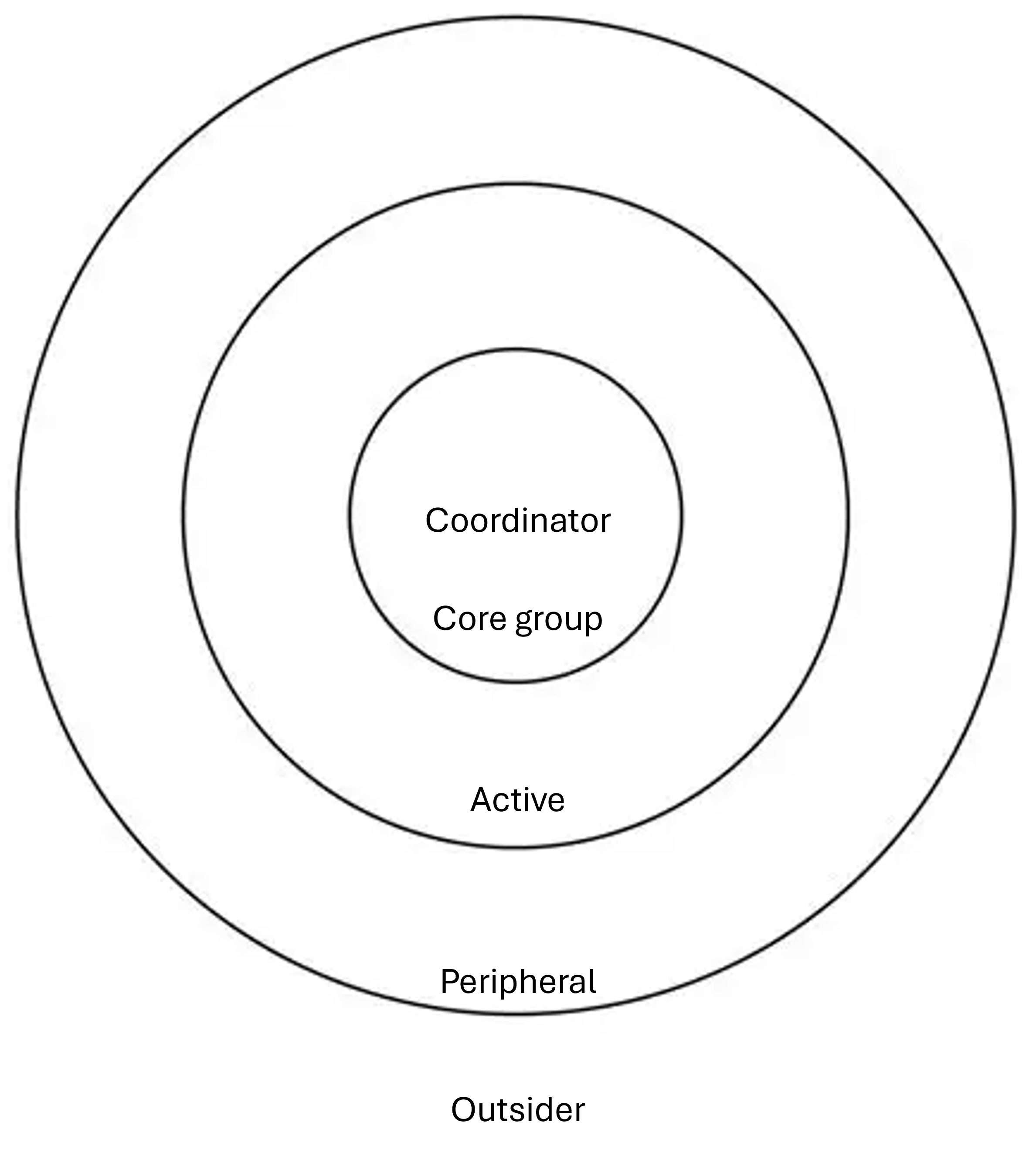
Figure 1. Reproduction of degrees of community participation (Wenger et al., 2002:57)
Ultimately, professional identity functions as a nexus of multimembership where individuals must reconcile various roles across shifting boundaries (Wenger, 2000). By navigating boundary crossings, practitioners act as brokers, introducing elements of one practice into another to sustain an integrated sense of self (Wenger, 2000). This dynamic participation ensures that identity remains a constant process of transformation within the broader landscape of practice (Wenger, 2000).
This paper goes further and also draws on Virtual Communities of Practice (VCoP). A VCoP consists of a group of people who engage in the social process of learning through digital rather than physical spaces (Hillier, 2015). These communities allow for mutual engagement to occur through virtual methods of communication, including via social media, email, or online forums (Wenger, 2000). VCoP gives those who are physically isolated the opportunity to engage in wider professional discussions (Rouxel, 2015) and makes mutual engagement possible even without geographical proximity (Wenger, 2000).
This can be important, as exclusion and non-participation in a CoP can lead to non-membership in a desired CoP, leading to both emotional pain and a sense of disconnect (Wenger, 2000). Further, this can also significantly hinder LPP (Lave & Wenger, 1991). This aligns with degrees of community participation (Wenger et al., 2002) (Figure 1), where the trajectory of participation can be tracked, with newcomers starting on the periphery, where they have legitimate access to ongoing activities but reduced responsibility. As they gain experience and are accepted by the group, they move toward full participation, which might look like active and then core participation (Lave & Wenger, 1991). Here it is seen that membership is not static, and that members move through levels of participation based on their interests and the community's focus (Wenger et al., 2002).
Within this framework, access to LPP leads to learning, which is viewed in terms of identity construction (Lave & Wenger, 1991), where individuals define who they are through their membership and history of engagement (Wenger, 2000; Wenger et al., 2002). However, for this to take place, they need to have access to a wide range of ongoing activities associated with the CoP, as well as to established community members and other members of the community (Lave & Wenger, 1991; Wenger, 2000). Barriers to participation can hinder this and is often written about in terms of the negative effects for newcomers if they are excluded or rejected from a community. This can include preventing the individual from moving inbound towards core membership, not achieving full participation, and potentially causing a reduced sense of professional self (Lave & Wenger, 1991; Wenger, 2000).
Trajectories of participation are not only understood in terms of inbound toward fuller membership; they can also lead outbound as individuals move away from a community (Wenger, 1998). Learning still occurs during departure because individuals reinterpret what they have learned and carry aspects of that identity elsewhere (Handley et al., 2006; Wenger, 1998). This process can often involve: a loss of a sense of belonging; re-negotiation of expertise; re-positioning oneself in new communities; and translating knowledge into new contexts (Nicolini et al., 2022; Wenger et al., 2002), which can cause a feeling of identity discontinuity. Further, leaving a CoP might lead to a loss of knowledge and community. When individuals leave, they may find that tacit, or sticky, knowledge may disappear, social networks weaken, mentoring relationships end, and community practices may change, as these tend to stay within a local practice (Nicolini et al., 2022; Wenger, 1998; Wenger et al., 2002). The outbound trajectory is often a gradual, rather than sudden, process. In the early stages of community disengagement and participant decline, the individual might engage in lurking, particularly in VCoP spaces, reduced participation, and silent membership (Wenger, 1998; Wenger-Trayner et al., 2023).
The ability to sustain a multifaceted identity relies heavily on brokering (Wenger, 2000). By taking elements of one practice and importing them into another, members can act as a bridge between distinct professional worlds and, in doing so, can make previously sticky knowledge leaky enough to cross boundaries and inform other practices (Nicolini et al., 2022).
Materials and methods
This self-study (Samara, 2011) draws on autoethnography (Adams et al., 2014) and degrees of community participation (Wenger et al., 2002), with both functioning as materials and methods. Together, they provide a framework for exploring the shift in participation across distinct CoPs (Lave & Wenger, 1991) and the resulting impact on the professional identities of artist and teacher-educator.
Autoethnography allows for an evocative written narrative constructed through memory work to be presented (Bochner & Ellis, 2016). This involves systematic introspection, where I actively recall thoughts and feelings from specific social standpoints, such as an exhibition opening and a teacher-educator event, to critique cultural and professional experiences. The presented vignettes serve as primary data for narrative-under-analysis (Bochner & Ellis, 2016), a process that treats stories as information to be theoretically interpreted rather than just told.
The memory work presented draws on a mundane epiphany, a seemingly ordinary moment that becomes life‑changing (Boylorn & Orbe, 2016) or reveals its transformative power through mundanity (Hodson, 2022). The two autoethnographic narratives from May 2026 illustrate different facets of this realisation. Within the first, the exhibition opening, the epiphany is one of loss and visceral realisation of isolation from the artist community, while the second, the teacher-educator event, presents an epiphany of acceptance. These two events and epiphanies together illustrate that my professional identity is not fixed but a nexus of multimembership in constant flux (Wenger, 2000; Wenger et al., 2002). The mundanity of these moments reveals how my location within these different CoPs directly reshapes my professional self.
Simultaneously, the degrees of community participation provide visual figures based on Wenger et al.'s (2002) model. These figures illustrate my position within these communities. By integrating these visual diagrams with the autobiographical narratives, the study produces a layered account (Bochner & Ellis, 2016) that renders the identity flux and boundary crossing (Wenger, 2000) between artist and teacher-education landscapes both tangible and visual.
Positionality
Within this self-study (Samara, 2011), I am positioned as a researcher-participant who is engaged in the social setting associated with artists and teacher-educators as an active participant. My positionality as a multifaceted professional (Cairns, 2025) is central to the study, as my own experiences become the primary subject of the inquiry. My identity represents a nexus of multimembership, shaped by the years spent as an artist and teacher-educator and constructed through my unique history and interactions.
This insider's perspective (Adams et al., 2014) facilitates a reflexive exploration of the identity flux inherent in balancing these diverse roles. My specific location within these identities is further articulated through degrees of community participation (Wenger et al., 2002), which visualise my movement between the core, the periphery, and the outside of different professional landscapes. Ultimately, I am a ‘person-in-the-world’ (Lave & Wenger, 1991) whose identity is not fixed but continually negotiated through my participation in distinct CoPs.
The autoethnographic narratives are situated within the framework of participation trajectories in CoPs (Wenger, 1998; Wenger-Trayner et al., 2023). As illustrated in Figures 2 and 3, my participation in the artist CoP is characterised by an outbound trajectory, reflecting a gradual movement away from core participation and toward the periphery of that community. In contrast, my participation as a teacher-educator follows an inbound trajectory, marked by increasing engagement, legitimacy, and responsibility within that CoP. These intersecting trajectories shape both my perspective and my interpretation of experience, positioning me simultaneously as a departing member of one community and an increasingly central participant in another.
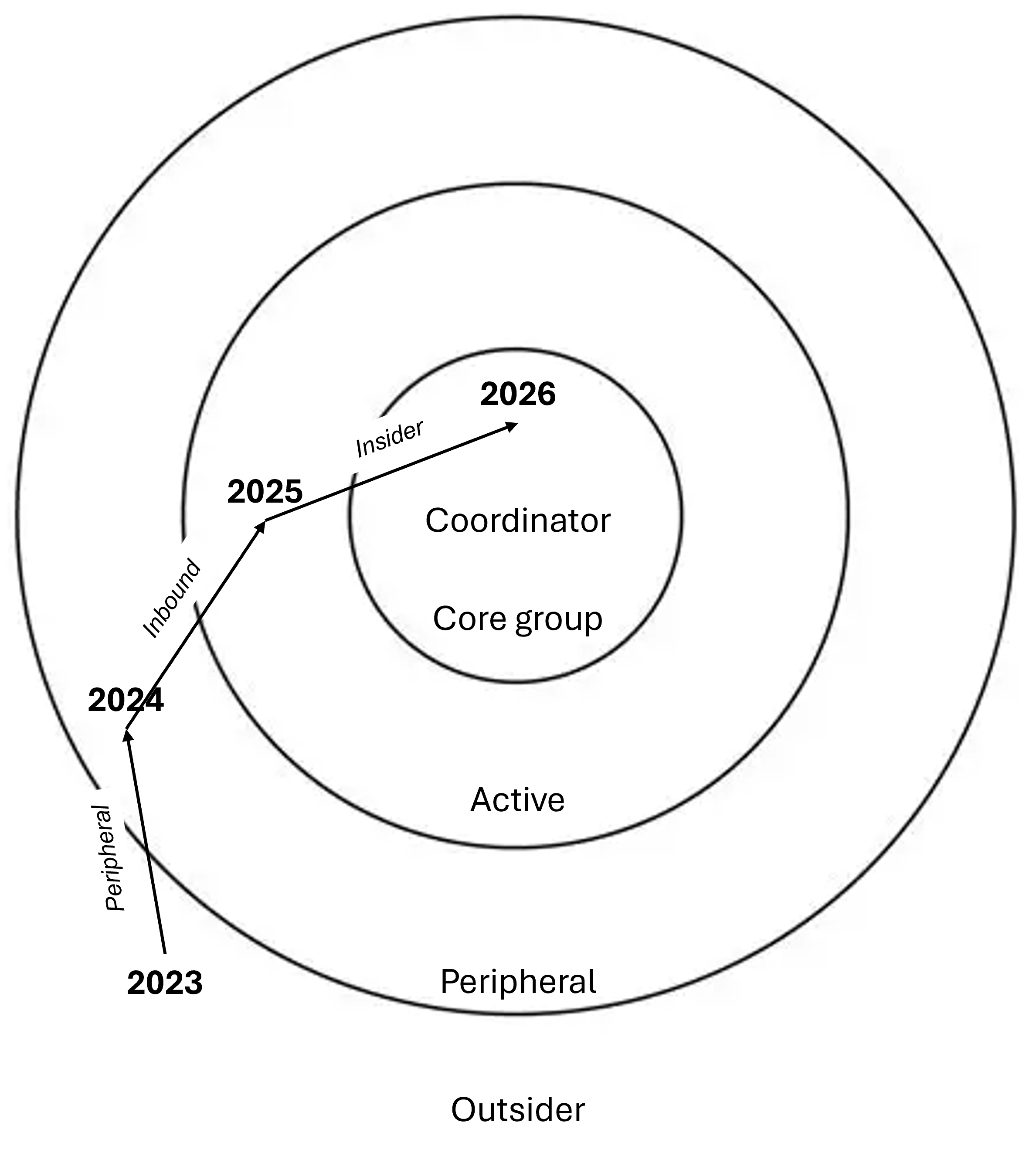
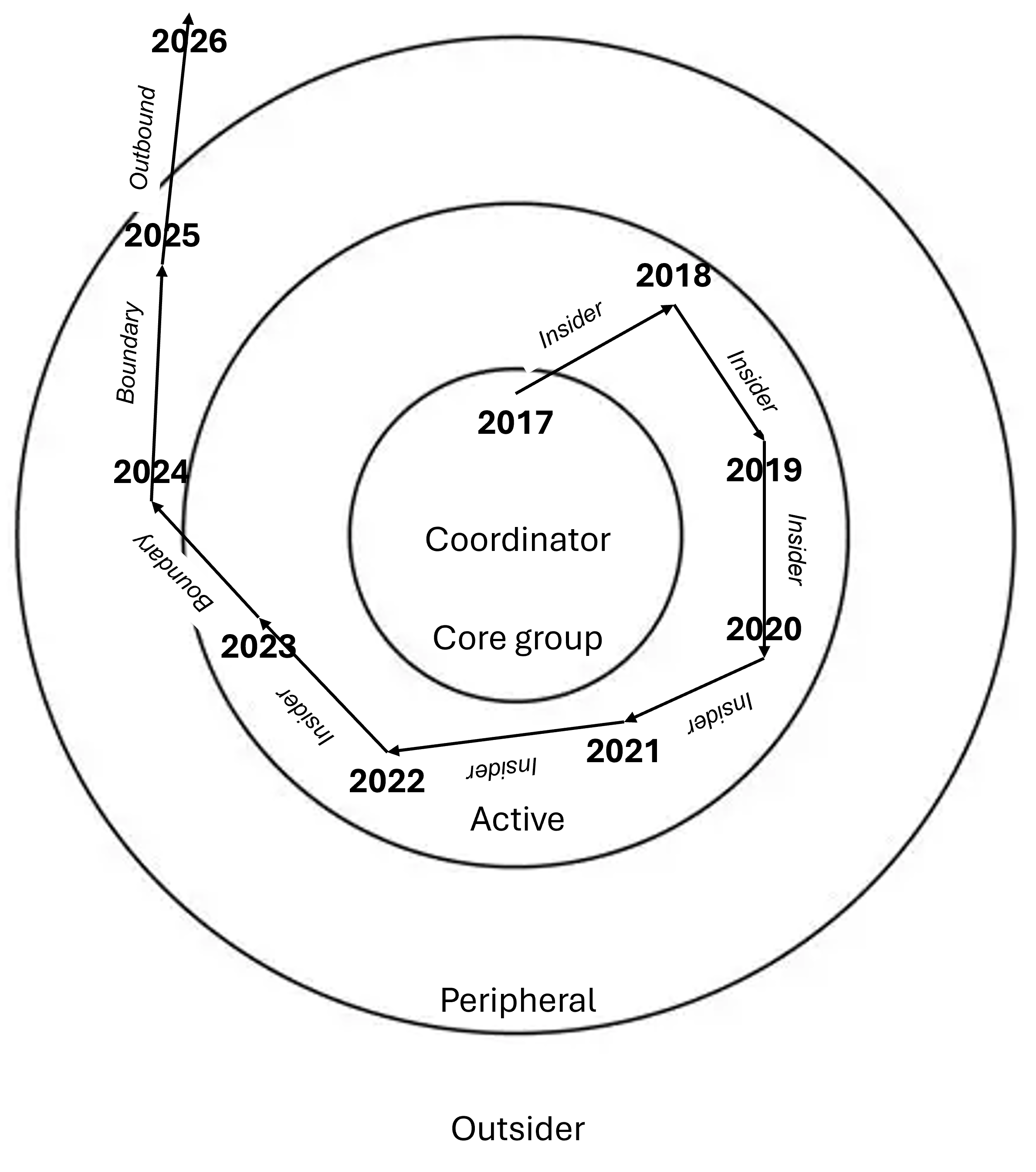
(L) Figure 2. Artist degrees of community participation trajectory
(R) Figure 3. Teacher-educator degrees of community participation trajectory
Ethics
As this research is a self-study (Samara, 2011) centred on my own professional experiences and identity flux, formal ethical approval was not sought, as such research often falls outside traditional human subject research (Bochner & Ellis, 2016). Nevertheless, the study adheres to a rigorous relational ethics of care (Adams et al., 2014).
The paper recognises that writing about the self inevitably involves writing about others (Adams et al., 2014), and specific measures were taken to protect the privacy of individuals and institutions within the autoethnographic narratives. All names and specific organisations have been anonymised or described through generic identifiers to ensure no harm or professional risk (Adams et al., 2014). Further, I engaged in systematic sociological introspection to maintain a reflexive and respectful stance, avoiding blaming and shaming others when representing the artist and teacher-educator communities under study (Adams et al., 2014).
Results
The exhibition opening
I stand at the private view and look around, one hand clutching my handbag, the other finding its way to fiddle with my necklace pendant. I arrived on time, or it would seem unfashionably early, and while this rewarded me with a parking space, I am now left to make small talk with the gallery owners, who reassure me several times that others are coming. With time to spare, I look around at the art, aware of the gallery owner's eyes on me. As I move slowly around the space, I pause at each artwork, lean in to see details, and step back to take in works hung above my eye level. Then I come to the labels. I always like to look at the art first, make up my own mind about what it is about or what it might be called. However, this evening I am less concerned with that; instead, my eyes are drawn to the artist's name. Name after name, there is no recognition of who they are. As I continue this dance around the space and the artwork, other artists begin to arrive in ones and twos at first, then in clusters as the evening moves on.
Although I retained the tacit cultural knowledge and trained habits necessary to interpret and aesthetically evaluate the artwork, I no longer possessed the social confidence required to participate fully in the community. This distinction highlights that belonging within a CoP involves far more than technical competence or historical familiarity. It demands ongoing mutual engagement, shared practice, and active recognition from peers.
With each new arrival, I feel a sense of relief from the gallery owners. Build it and they will come; or at least put on a local art exhibition and local artists will come. The door makes a sound each time it is opened, and as if conditioned, I look at it each time. The faces of these artists' names are appearing, and I am still none the wiser as to who anyone is. As the room becomes fuller, it becomes clearer that others know each other. While the door opening makes my hand return to fiddle with my necklace, it makes others reach out and greet each other by name. Snippets of overheard conversations about other exhibitions, workshops, and family updates make me retreat to the edges. I try to join the conversation, but there is a feeling of intrusion and an awkward hanging onto the edges. Once no connection can be traced, artists turn and move away towards familiar faces. I wait for the opening speech and then, without anyone to make my excuses to, leave without a trace.
My physical act of retreating to the edges functions as a material manifestation of an outbound trajectory towards peripheral and outsider status. Rather than experiencing active exclusion, my disengagement was characterised by a lack of mutual engagement, a sign of silent membership and lurking where I remain physically present but socially disconnected. Choosing to leave without a trace reveals how non-participation operates as an invisible exit. Without established social ties to the current joint enterprise, my departure required no explanation, signalling my transition from the core to the periphery of the artistic community.
Aptly, it is raining, despite it being summer, making the early evening darker than it needs to be. I run across to my car and sit in the driver's seat. I have only been here an hour or so, and at least half of that was spent on my own, though I reflect that I was the most at ease I had been all evening, even under the gaze of the gallery owner earlier. It was only when others arrived that the real feeling of isolation started. Now back in my car, alone again, I feel at ease, but a huge sense of loss for a community I had not noticed I was slipping away from quietly, or more literally, silently this evening.
Sitting alone in the car provided a visceral moment of mundane epiphany. The comfort of solitude contrasted with the emotional discomfort experienced inside the room, exposing the effective toll of identity flux. The sense of loss was not triggered by a single hostile event, but by the sudden realisation of gradual, unacknowledged disengagement over time, demonstrating that outbound trajectories are often silent, temporal processes until a specific threshold moment brings the loss of belonging into focus.
The teacher-educator event
As I arrive in the college car park and make my way to reception to sign in, I bump into a colleague, and we greet each other warmly, making the rest of the short walk to reception together, catching up as we go. As we enter the large, glass-fronted building buzzing with learners and staff, we spot two more colleagues and the hosts for the teacher-educator event we are here for. I have not met these two colleagues before, but they know the one I bumped into earlier, and I am introduced. One of them had seen something I had posted on LinkedIn, and we chatted about this as we signed in and then made our way up the flight of stairs to the room we will be meeting in with more teacher-educators.
These initial interactions functioned as moments of social recognition that signalled legitimacy within the teacher-educator community. Being recognised through a prior LinkedIn post shows how digital activity acts as a boundary object, bridging VCoP with physical spaces. Being welcomed through a connection facilitates an immediate inbound trajectory, allowing me to enter the physical space not as an intrusive outsider, but as an acknowledged colleague with legitimate peripheral standing.
We arrive at the room right on time, but others have beaten us there. I spot some colleagues I know from other spaces, in person and online, and make my way around them, stopping to be introduced to the many I have not met before. As everyone makes their rounds with introductions and reintroductions, others arrive. The session is already running slightly behind because everyone is occupied with chatting. The room is full and fuelled by tea. As one of the hosts calls us all to attention and asks us to take our seats, we all oblige. I find myself at a table with four colleagues I have not met before, but conversations continue to flow, and contact details are quickly shared, LinkedIn connections added. There is an instant acceptance, and as I speak and contribute, I am supported, challenged, and cheered on.
Being supported highlights a shift from peripheral observation to active, mutual participation. In contrast to the gallery event, this environment provided instant social validation. The rapid exchange of contact details and digital connections reinforced a shared regime of competence, transforming potential anxiety into professional warmth and confirming an accelerating inbound trajectory toward the core of the teacher-educator network.
The end of the session arrives, and there is a reluctance to leave a space so warm. I exit with two new colleagues, and we continue to share ideas as we descend the stairs we climbed just a few hours earlier, and make our way to reception to sign out, returning our lanyards and thanking the staff. As we exit the building, the site is still busy with learners. We stop and chat for a moment longer as one colleague has parked close by, and we walk them to their car before we finally bring ourselves to say goodbye with a promise to keep in contact.
The lingering conversations on the stairs and in the car park demonstrate how shared practice generates a sense of collective purpose that spills beyond formal institutional boundaries. The reluctance to leave stands in direct opposition to my trace-less exit from the gallery, illustrating how social warmth and mutual engagement foster a renewed sense of professional belonging and identity commitment.
Comparative synthesis
Read together, the two autoethnographic vignettes presented function as complementary narrative data that make visible the flux of a multifaceted professional identity. Rather than existing as isolated accounts, a comparative analysis of them reveals shared structural mechanisms, opposing participation trajectories, and a deeper insight into identity continuity.
At their core, both events represent critical sites of identity negotiation, where professional selfhood is actively contested and reframed across social boundaries. In each vignette, my subjective experience hinges on social recognition, legitimacy, and the search for belonging within a CoP. Neither presents a neutral background; each demands that I navigate implicit norms, regimes of competence, and social signals to establish standing. In both, belonging is demonstrated as an ongoing social accomplishment rather than an automatic status.
However, despite these shared mechanisms, the two vignettes show fundamentally opposing participation trajectories and affective outcomes. The exhibition opening captures my outbound trajectory, characterised by a loss of mutual engagement, silent disengagement, and slipping away towards outsider status. The lack of peer recognition forces a retreat to the edges, culminating in a silent exit and an acute affective sense of isolation and loss. Conversely, the teacher-educator event reflects an inbound trajectory fuelled by LPP. Here, digital boundary objects (e.g., the LinkedIn post) and mutual introductions establish early legitimacy, facilitating rapid acceptance, active contribution, and a feeling of professional warmth and purpose.
Synthesising these two narratives reveals that professional identity transformation is neither linear nor binary and that identities are not simply gained or discarded. Instead, the vignettes demonstrate simultaneous identity movement across a shifting constellation of practices. While I disengage from the social core of the artist community, the community itself does not vanish. Further, my trained habits of artistic inquiry remain active and are carried across boundaries. Through brokering, this tacit specialist knowledge is translated and imported into pedagogical practice, enabling the emergence of an integrated artist, teacher-educator identity. Disengagement from one community creates the necessary boundary space for knowledge transfer and pedagogical innovation in another.
Discussion
This discussion brings together the mundane epiphanies presented in the autoethnographic narratives with the theoretical framework of CoPs to explore the fluid, temporal nature of multifaceted professional identity within the HE-in-FE landscape in the UK. By weaving together the visceral experiences captured in the vignettes (Boylorn & Orbe, 2016; Hodson, 2022), with the structural models of participation, the research renders the invisible work of identity transformation tangible and elevates the narratives from personal storytelling to a rigorous showing of reasoning.
The affective consequences of shifting trajectories
The findings illustrate a stark contrast between the outbound trajectory experienced within the artist community and the inbound trajectory within the teacher-educator network (Wenger, 1998). In the exhibition opening, the "dance around the space" and the inability to recognise names signify a move from the core toward a peripheral or outsider status (Wenger, 1998). This transition is not merely a change in location but a visceral realisation of isolation that triggers a deep sense of loss (Wenger et al., 2002). This aligns with Wenger’s (2000) assertion that identity is as much a form of non-belonging as it is belonging, as we define ourselves as much by the practices we do not engage in as by those we do. The "awkward hanging onto the edges" described in Vignette 1 exemplifies the silent membership and lurking characteristic of disengagement, where the member remains present but lacks the mutual engagement required for core membership (Wenger, 1998; Wenger-Trayner et al., 2023). According to Wenger et al. (2002), peripheral members often keep to the sidelines, watching the interactions of the core and active members without active contribution.
Within the gallery setting, the inability to establish mutual engagement signifies a movement towards outsider status (Wenger et al., 2002). This transition is not merely a location change, but a visceral realisation of isolation that triggers a sense of loss. This is a state of silent membership and lurking that reflects community disengagement (Wenger-Trayner et al., 2023). Crucially, outbound trajectories are transformative rather than destructive, as even as members disengage from the social core of a practice, they retain their histories of participation, tacit knowledge, and trained habits (Handley et al., 2006; Wenger, 1998). Further, disengagement from one community creates the necessary boundary space to reframe identity and carry those resources to a new CoP (Nicolini et al., 2022). This demonstrates that while I am exiting the social core of the community, I still carry the tacit knowledge and ingrained habits of an artist. However, my attempt to "join the conversation" suggests a lingering desire for legitimacy, even as I eventually choose to "leave without a trace". In this act, and even within my outbound trajectory (Figure 2), the way in which I decide to leave the artist CoP engages the innovating lens by forcing me to embrace identifying in a new way and with an alternative community (Wenger-Trayner et al., 2023).
Conversely, the teacher-educator gathering represents an inbound trajectory defined by LPP and immediate social validation (Lave & Wenger, 1991; Wenger et al., 2002). Movement toward the core in this context was facilitated by boundary objects, which bridged VCoPs with physical professional spaces (Hillier, 2015; Rouxel, 2015; Wenger, 2000). This digital presence established pre-existing credibility, enabling rapid acceptance and active contribution among previously unmet peers. Viewed through the defending lens (Nicolini et al., 2022), this rapid inclusion reveals the operation of implicit regimes of competence and shared jargon. The prior digital interaction demonstrated alignment with community norms, granting legitimate access where an unaligned newcomer might otherwise encounter gatekeepers.
The mundane epiphany as a catalyst for integration
The concept of the epiphany is key to memory work, and a central contribution of this study is the identification of the mundane epiphany as the moment where the shifting identities of artist and teacher-educator intersect (Boylorn & Orbe, 2016; Hodson, 2022). By treating these narratives as data, I have been able to tease out the concepts and patterns within the autoethnographies to show how my personal experience contributes to theory.
Wenger (2000) explains that we belong to "several CoPs at any given time" (p. 6), and the challenge for the multifaceted professional is to reconcile these various forms of membership into a single, albeit complex, identity. The intersection where my shifting identities meet is found in the contrast between the two events. In Vignette 2, I experience the opposite of isolation. Further, the emergence of my integrated artist, teacher-educator identity is supported by acts of brokering. For example, when a colleague mentions a LinkedIn post, showing how my digital professional identity acts as a boundary object that facilitates my entry into a new community. My reluctance to leave the "warm" space of the teacher-educator event versus the "trace-less" exit from the gallery highlights the ongoing challenge of reconciling these different forms of membership. While one identity feels like it is slipping away, the other is actively becoming through mutual engagement and shared ideas. Although I am moving away from core artist membership (Wenger et al., 2002) (Figure 1), the tacit knowledge and histories of participation from that community are not entirely lost; instead, they are reinterpreted and carried into the new teacher-education context (Nicolini et al., 2022; Wenger, 1998; Wenger et al., 2002).
Brokering and professional survival in HE-in-FE
The overarching realisation that my artistic inquiry into symbols and signs spilled over into my pedagogical session plans provides concrete empirical evidence of brokering in practice and helps sustain my integrated identity (Wenger, 2000). By translating the tacit, localised, sticky knowledge of artistic inquiry into accessible, leaky pedagogical frameworks, I acted as a boundary spanner between two distinct professional worlds (Nicolini et al., 2022). Viewable through the innovating lens (Nicolini et al., 2022), this import-export of vocational knowledge functions as a strategic form of content innovation within HE-in-FE. This act of import-export is vital for personal professional survival within HE-in-FE (Nicolini et al., 2022; Wenger, 2000). As noted in the literature review, entering teacher education required a profound recalibration of the self and a shift toward a meta-pedagogical focus (Loughran, 2006; Murray & Male, 2005; Shulman, 1986). Rather than abandoning vocational roots (Murray & Male, 2005; Shulman, 1986), brokering enabled me to remedy identity discontinuity, transforming potential professional loss into a transferable pedagogical resource.
At the gallery, as I navigate leaving the artist CoP, I do not successfully broker my current identity and experience isolation and loss. This makes the defending lens particularly effective for analysing the gatekeeping and exclusion encountered at the gallery opening (Lave & Wenger, 1991; Nicolini et al., 2022). Rather than interpreting the moment as a purely personal setback, the defining lens situates it within broader socio-political dynamics in which the artist community actively constructs barriers to safeguard its expertise and maintain authority over its domain (Nicolini et al., 2022; Wenger et al., 2002). In contrast, the teacher-educator event is described as warm. By successfully bridging my identities through conversation and shared digital presence, I find a space where I can access established community members (Lave & Wenger, 1991). Within the autoethnographic narratives, this warmth is presented as the essential antidote to the isolation often found when navigating shifting professional constellations. However, as established in the literature review, this sense of professional warmth must be situated within the broader precarity and contract insecurities of the HE-in-FE sector (Colley et al., 2007; Hafez, 2017). Structural job insecurity threatens the long-term stability of such communities, potentially disrupting LPP and the ongoing social warmth of teacher-educator networks (Nicolini et al., 2022).
Identity as a shifting constellation
Ultimately, the integration of visual degrees of community participation (Wenger et al., 2002) (Figures 2 and 3) and autoethnographic memory work (Bochner & Ellis, 2016) renders these shifting constellations tangible. The research confirms that identity is not fixed but a constant process of transformation (Wenger, 2000). The movement between the core of the teacher-educator network (Figure 3) and the periphery of the artistic world (Figure 2) is not a failure of participation but a necessary boundary crossing that facilitates the circulation of knowledge across the broader landscape (Wenger et al., 2002).
By embracing the role of the broker and boundary spanner, and acknowledging the affective consequences of these shifts, multifaceted professionals can sustain a unified, albeit fluid, sense of self within the complex social landscapes (Wenger et al., 2002). Further, by engaging with the learning that occurs during the outbound trajectory of a CoP, I am reinterpreting that artistic identity to carry it elsewhere, rather than just viewing it as a loss.
Sustaining a multifaceted identity
Navigating the meta-pedagogical shift within HE-in-FE required a profound recalibration of self (Loughran, 2006; Murray & Male, 2005; Shulman, 1986). Brokering enables practitioners to navigate this tension without abandoning their vocational roots. The autoethnographic narratives capture my nexus of multimembership by showing me navigating two very different regimes of competence. I move from hanging on the edges (Figure 2) to a space where conversations flow, and contact details are exchanged among teacher-educators (Figure 3). The ability to carry these histories of participation and reinterpreting moments of loss and gain into data for my research is the ultimate act of brokering that allows me to reconcile these roles into a single, complex identity. By acting as a boundary spanner, I have been able to theorise my integrated identity as a strategic asset that translates artistic inquiry into pedagogical practice to overcome the identity discontinuity I faced (Nicolini et al., 2022; Wenger et al., 2002). As the literature suggests, entering teacher education requires a profound recalibration of the self and a shift towards a meta-pedagogical focus (Loughran, 2006; Murray & Male, 2005; Shulman, 1986). Brokering allows me to navigate this recalibration without abandoning my vocational roots.
Implications
Beyond the theoretical insight into identity flux, the paper offers actionable implications for those navigating multifaceted professional roles and the institutions that support them. Firstly, there is a call to recognise identity loss and CoP withdrawal as legitimate professional development work. Outbound trajectories for CoP are often experienced as a personal loss, rather than a sign of growth; however, navigating non-membership and stepping back from a previously core specialist role is an active, meaningful component of professional identity work.
There is a need for intentionally designed teacher-educator communities for newcomer recognition and belonging. As practitioners move along inbound trajectories into teacher-educator CoPs, LPP depends on early social validation and mutual engagement. Teacher-educator communities, both physical and virtual, must intentionally create accessible entry points, clear opportunities for recognition, and a welcoming space that fosters rapid connections to counteract feelings of isolation and to accelerate the newcomers' trajectory towards active participation. Further, the sector should treat previous professional identities as transferable resources rather than as roles to leave behind. Building on the meta-pedagogical recalibration outlined earlier, institutions must recognise that specialist vocational identities (e.g., the artist identity) should not be discarded upon entering teacher education. Instead, HE-in-FE institutions should actively facilitate brokering and boundary crossing, enabling teacher-educators to import tacit vocational knowledge into their pedagogical practice to foster content innovation and sustain a unified sense of self.
Conclusion
Utilising evocative autoethnography (Adams et al., 2014) and self-study (Samara, 2011) ensures that this research is not merely navel-gazing but a rigorous academic inquiry. By positioning the self as the object of research, the study acknowledges that knowledge is embodied and situated (Adams et al., 2014). The use of memory work in this study is particularly effective because remembering is an active, dynamic process that involves continual movement and vitality rather than being an act of passive recall (Bochner & Ellis, 2016). This methodological choice has allowed me to work back and forth between the generation of meaning and the narrative truth of the lived experience (2016).
As a self-study, this research is bound to my own lived experiences as the researcher-participant navigating multifaceted professional roles. The qualitative data relies on two specific critical incidents: the gallery opening and the teacher-educator meeting, which function as evocative mundane epiphanies, rather than as exhaustive accounts of professional life. Due to this, the findings are not intended to be representative of all artists or of all teacher-educators operating in HE-in-FE contexts in the UK. Instead, the study is intended to provide deep, contextual insights into the affective dynamics of identity flux, disengagement, and boundary crossing. The theoretical framework of shifting constellations and brokering offers a transferable lens for analysis, while the narrative claims remain deliberately situated within these two specific moments.
Ultimately, the study has shown that the integration of visual degrees of community participation and autoethnographic narratives confirms that identity is not a fixed destination but a constant process of transformation. The movement between the core of the teacher-educator network and the periphery of the artistic world is not a failure of participation but a necessary boundary crossing that facilitates the circulation of knowledge across the broader landscape of practice. By embracing the role of the broker and acknowledging the affective consequences of these shifts (Wenger et al., 2002), multifaceted professionals can sustain a unified sense of self within the complex social landscapes of contemporary education.
To build upon the insights gleaned by this self-study, future research could expand on some key areas, including examining how larger cohorts of vocational practitioners in HE-in-FE UK contexts navigate shifting participation over time, testing whether inbound trajectories to teacher communities systematically buffer the loss of outbound subject-specific communities.
References
Adams, J. (2007). Artists becoming teachers: Expressions of identity transformation in a virtual forum. International Journal of Art & Design Education, 26(3), 264–273. https://doi.org/10.1111/j.1476-8070.2007.00537.x
Adams, T. E., Jones, S. H., & Ellis, C. (2014). Autoethnography (Understanding Qualitative Research). Oxford University Press.
Karen Anderton (2023, June 22). How the legacy of the FEPDG might just ensure Cinderella shall go to the ball. Association of Colleges. https://www.aoc.co.uk/news-campaigns-parliament/news-views/aoc-blogs/how-the-legacy-of-the-fepdg-might-just-ensure-cinderella-shall-go-to-the-ball-karen-anderton
Bochner, A. P., & Ellis, C. (2016). Evocative autoethnography: Writing Lives and Telling Stories. Routledge. https://doi.org/10.4324/9781315545417
Boylorn, R. M., & Orbe, M. P. (2016). Critical autoethnography: Intersecting cultural identities in everyday life. Routledge.
Bucura, E. (2022). Music teacher identities: Places, people, and practices of the professional self. Waxmann Verlag GmbH.
Cairns, A. (2025). Exploring Your FE teacher identity: A CPD toolkit. Routledge.
Colley, H., James, D., & Diment, K. (2007). Unbecoming teachers: Towards a more dynamic notion of professional participation. Journal of Education Policy, 22(2), 173–193. https://doi.org/10.1080/02680930601158927
Hafez, R. (2017). Inside the Trojan horse: Educating teachers for leadership. In M. Daley, K. Orr & J. Petrie (Eds.), The principle: Power and professionalism in FE. Trentham Books (pp. 171–176).
Handley, K., Sturdy, A., Fincham, R., & Clark, T. (2006). Within and beyond communities of practice: Making sense of learning through participation, identity and practice. Journal of Management Studies, 43(3), 641–653. https://doi.org/10.1111/j.1467-6486.2006.00605.x
Hillier, Y. (2015). Conclusion: Leading a merry dance through time of change and challenge. In M. Daley, K. Orr & J. Petrie (Eds.) Further education and the twelve dancing princesses (pp. 165–173). UCL IOE Press.
Hodson, G. J. (2022). Aftercare: Becoming. Journal of Autoethnography, 3(2), 262–266. https://doi.org/10.1525/joae.2022.3.2.262
Lave, J., & Wenger, E. (1991). Situated learning: Legitimate peripheral participation. Cambridge University Press. https://doi.org/10.1017/CBO9780511815355
Loughran, J. (2006). Developing a pedagogy of teacher education: Understanding teaching and learning about teaching. Routledge.
McAdams, D. P. (1993). The stories we live by: Personal myths and the making of the self. William Morrow & Co.
Murray, J., & Male, T. (2005). Becoming a teacher educator: Evidence from the field. Teaching and Teacher Education, 21(2), 125–142. https://doi.org/10.1016/j.tate.2004.12.006
Nicolini, D., Pyrko, I., Omidvar, O., & Spanellis, A. (2022). Understanding communities of practice: Taking stock and moving forward. Academy of Management Annals, 16(2), 680—718. https://doi.org/10.5465/annals.2020.0330
Petrie, J. (2015). Introduction: How Grimm is FE? In M. Daley, K. Orr & J. Petrie (Eds.), Further education and the twelve dancing princesses (pp. 1–11). UCL IOE Press.
Rouxel, D. (2015). Dancing in plain sight. In M. Daley, K. Orr & J. Petrie (Eds.), Further education and the twelve dancing princesses (pp. 131–137). UCL IOE Press.
Samara, A. P. (2011). Self-study teacher research: Improving your practice through collaborative inquiry. SAGE Publications. https://doi.org/10.4135/9781452230481
Shulman, L. S. (1986). Those who understand: Knowledge growth in teaching. Educational Researcher, 15(2), 4–14. https://doi.org/10.3102/0013189X015002004
Steadman, S. (2023). Identity: Keywords in teacher education. Bloomsbury Academic. https://doi.org/10.5040/9781350285958
Wenger, E. (1998). Communities of practice: Learning, meaning, and identity. Cambridge University Press. https://doi.org/10.1017/CBO9780511803932
Wenger, E. (2000). Communities of practice and social learning systems. Organization, 7(2), 225–246. https://doi.org/10.1177/135050840072002
Wenger, E., McDermott, R. A., & Snyder, W. M. (2002). Cultivating communities of practice: A guide to managing knowledge. Harvard Business School Press.
Wenger-Trayner, E., Wenger-Trayner, B., Reid, P., & Bruderlein, C. (2023). Communities of practice within and across organizations: A guidebook (2nd ed.). Social Learning Lab.
Westminster Hall. (2021). Westminster Hall debate: Third report of the education committee, A plan for an adult skills and lifelong learning revolution, HC 278. 15 April 2021, 1.30pm. https://parliamentlive.tv/event/index/f3d210ee-0aab-4050-9fe5-e8b09e5f4ed2