Darkness and light in times of war
Galyna Solovei1
1 The University of “Kyiv-Mohyla Academy”, Kyiv, Ukraine;
Abstract
This paper represents the autobiographical reflections of an individual academic, and how her career aspirations, Covid, and war impacted on her and her family’s evolving identity.
Keywords
autobiography, family, displacement, culture, war
1. Starting point
Throughout my career, I worked as a researcher at the Institute of Philosophy, at the press centre of the Ministry of Social Policy, and headed the Department of International Treaties at the Ministry of Education. Yet, I only found my dream job in 2019, at the wonderful age of 40. And it is truly remarkable, because my real family was, at the same time, the family of my dreams.
But this dream family—my husband, a diplomat, and our three daughters, who were born right after I received my PhD and published five scholarly articles—took so much of my time and energy, while also bringing immense joy, that I never thought I would ever emerge from my prolonged maternity leave. Then one night, I dreamed of my own gravestone. On it was written: “Our Halya married well and gave birth to three children.” Period. That final period terrified me so much that I woke up screaming.
The horror of “dissolving into family life” pushed me to pursue a second higher education in international development in South Korea and, ultimately, to return to my alma mater—not as a student, but as a lecturer. My husband supported me wholeheartedly: without hesitation, he agreed to stay behind as a single father of our three girls—aged 12, 10, and 5—for an entire academic year, proving his love and devotion to me forever.
Thus, I became a lecturer, something I had longed for. My life before teaching at Mohyla Academy was happy, but incomplete. Each day, arriving at the Academy and breathing its air, I rejoiced in absolutely everything happening there: interacting with students, collaborating with colleagues at the Department of International Relations, and engaging with international lecturers and researchers.
2. Courses and projects
I was warmly welcomed to Mohyla Academy to teach courses in English at the newly established Department of International Relations. At first, I taught Negotiations and Mediation and Qualitative Research Methods. The following year, four more courses were added: together with German colleagues, I developed two courses on the analysis of violent international conflicts for both bachelor’s and master’s levels; and together with Canadian colleagues, we created and co-taught courses on international organisations and a special course on UN activities, which included participation in a simulation of a UN committee session.
At the same time, I supervised the student UN Model Club, where the best students were rewarded with a trip to New York for “the world’s main Model UN”—a week-long student conference usually held during Easter break.
So, I carried a teaching load of 150 percent—the highest legal teaching load in Ukraine. At times, it was challenging, especially during exam sessions. And I had no time for research. But working intensely, in English, and with international partners prepared me for the challenges ahead.
3. Could anything be worse than Covid-19? Without a doubt.
The pandemic that began in the winter of 2020 ruined many of our plans: German colleagues could not come to Kyiv for intensive conflict analysis seminars in the winter of 2021, and in April of that year, my students and I could only participate in the New York Model UN online.
However, we learned to “socialise online”, bringing into virtual communication the warmth and inspiration that is usually born between teacher and students.
In August 2022, as the pandemic loosened its grip a little, a colleague and I went to Berlin for a week, where we met our German partners in a beautiful, lively city full of tourists. “This is only half the usual number of tourists,” commented the Berliners. In October, three German colleagues came to Kyiv. They joined our international relations master’s students along with all Erasmus students who had come to Kyiv. It was genuinely joyful.
“What do you expect from this course?” we asked the students at the start of the seminars.
“The course is held in person—we see each other, we talk!” replied one student. “I am already happy—could there be anything better?”
“Covid is over, life is returning to normal,” added a student from Scotland, “we are in Kyiv, and this is a wonderful city.”
The feeling that our isolation from one another was ending grew stronger when our Model UN team received an invitation to the “World Model UN” in New York. Yet, the sense of looming danger “from another side” grew stronger too. On February 11, 2022, we obtained visas at the U.S. embassy. It was the embassy’s last day of work in Kyiv before its evacuation.
4. My family
The main family story we tell our daughters, and one we all believe—because it is true—goes like this:
When Mom and Dad met, there was so much love between us that we simply could not keep it to ourselves. We wanted a child almost immediately, when we were still in our early twenties. But no child came for five long years. We waited, hoped, and prayed. Then Maria was born. And there was even more love, overflowing from us. Then Sasha was born. After a short rest—Dad was sent to Mexico, Mom was no longer working two jobs while raising two kids—the energy and love overflowed again, and it seemed unbearably empty without another child. Then Nastya was born. Now our pack was complete. We would raise our daughters in love, allow them to choose their own paths, and Mom and Dad would always be together, dying on the same day.
To secure the family’s well-being, in 2020 we decided to buy an apartment and made the first payment. At last, I was fully earning my own income. We agreed that for his next diplomatic posting to Minsk, my husband would go alone. I would not leave my job; I would support our daughters, and he would put all his earnings into our new dream apartment by the park.
Separation from husband and father was very hard for us, but the goal was beautiful: we would live in a spacious apartment, sell the old one, buy studios for our two eldest daughters, and give them a good start and the chance to live independently as students.
My husband left for Minsk in June 2020. Before the war, the girls and I travelled by bus to Belarus to spend New Year’s 2022 with him. On January 5, 2022, as he hugged us goodbye, our youngest daughter burst into tears. He cried too. Such a thing was rare. Never before had I seen my husband, unashamedly, cry in public. But both he—41 years old—and our nine-year-old Nastya sobbed, clinging to each other at the Minsk bus station, as if it were the last time they would meet.
5. The beginning of the invasion
In the winter trimester, I was teaching two courses at Mohyla Academy: Qualitative Research Methods for second-year students and Introduction to Conflict Analysis and Peacebuilding for third-year students. The conflict analysis course was part of a 2020–2023 cooperation project with German lecturers, which was truly valuable, as I learned a great deal from them.
On the day of the invasion, one of our guest lecturers was supposed to hold a session. Bombing of Kyiv began at 4 a.m., and around 6 a.m. the rector of Mohyla Academy, Serhiy Kvit, sent an email to all staff announcing that classes were suspended due to the full-scale invasion. Still, I wrote to both my students and the foreign lecturer suggesting we might meet online, just to see one another, if anyone wished.
I was fairly calm. I did not wake the children at night; I did not call my parents, letting them sleep. I was convinced everything would be fine, that nothing bad would happen to us. The only thing—I kept going out to smoke on the shared balcony, where I saw our neighbours from Donetsk, who had bought an apartment in our building back in 2014, rushing out at 4:30 a.m. with just a few belongings, loading their car, and driving away. By 10 a.m., when I decided to start the lecture, most cars that usually filled our courtyard had already left—packed with belongings, pets, and families.
Out of 47 students, only six joined the meeting. In their chat, most were writing about leaving cities, stuck in traffic jams, scrolling through news feeds. One student had moved with her cat to her father’s office, deciding to stay there for now. Our foreign lecturer wished everyone safety and strength, and that was the end of the session. It was impossible to gain new knowledge while being attacked personally, while your family and your country were under assault from a nuclear power.
Now we ourselves were in the whirlpool of conflict—one we could only analyse later, if we managed to emerge from it alive. Personally, I had no doubt. I was convinced that within weeks we would drive the Russians out. My husband told me the same. By then, he could no longer send me money from Minsk, as Belarus had been cut off from payment systems. Our bus tickets for March 1 were cancelled by the carrier. He was convinced Kyiv was safe.
So, I was left in Kyiv with our three daughters. And within a few days, I no longer believed it was safe for them.
6. The Netherlands
On the fourth day of the war, Mexican journalists contacted me. They wanted to hear eyewitness accounts of how Russian troops were entering Kyiv, how we were being bombed, how we were dying and surrendering. I told them that my children were already sleeping in tracksuits so that, when the siren went off, we could quickly go down to the basement. I explained that I saw only Ukrainian equipment and troops in the city and said that we would fight until the end—that the Russians would not take Kyiv. That Russia and Putin were guilty of this aggression, and that Mexico should condemn this war and try to stop the Russian invasion at the diplomatic level. The anchor promised that all viewers would pray for me and my daughters—that was the only way they could help.
Prayer does help, but not as the only means—it works more like meditation before making a decision. For several weeks already, Geert, my Dutch friend and former classmate from South Korea, had been writing to me in Messenger, urging me to come with my daughters to the Netherlands. He had long lived apart from his parents, but they had decided to host Ukrainian refugees for three months. “Hey, I’m not a refugee! Hey, what three months? This is terrifying right now. Maybe we’ll come for a few weeks, but we’ll leave very quickly. The Armed Forces of Ukraine will repel the attack! The international community will stop this absurdity!”
So I gathered my daughters: sixteen-year-old Maria, fourteen-year-old Sasha, and nine-year-old Anastasia—who resisted and did not want to go anywhere—and decided to leave home. I took only a bank card, some cash, documents, three laptops, a change of clothes, and for each daughter a phone and a paper book.
We spent one night in Lviv, one night in a refugee camp in Poland, one night in central Berlin with a wonderful family of a mother and three daughters, and then, on a free train, reached the Netherlands, where Geert met us and brought us to Lelystad, to his parents’ home. I described this whole journey in detail, and it was published in a South Korean newspaper with the help of KDIS staff (Solovei, 2022).
We arrived in Lelystad on March 4, the very day the EU adopted the decision to activate the Temporary Protection Directive. The next day I wrote to Scholars at Risk. Three days later, Marlies Glasius, who at that time headed the Department of Political and Social Sciences, invited me to an interview and offered me to teach two courses: Security Studies and, together with Dr. Charlotte Hille, a research seminar on thesis writing. Starting March 15, I had a three-month Visiting Scholar contract at the University of Amsterdam. At the same time, online teaching resumed both at Kyiv-Mohyla Academy and at my daughters’ school.
Every evening I phoned my parents. The [Russians] were moving along the Chernihiv–Kyiv highway and occupying the railway junction at Zavorichi. They did not reach my native village by just two kilometres; there was nothing strategic there.
“The mines explode on the outskirts of the village only because the Russians are clumsy and their shells don’t fly where they’re supposed to!” —my seventy-year-old father laughed over the phone.
They had already lived for a month without water and gas because the pipes had been damaged somewhere, but there was still electricity and internet.
My best friend, with three children, two cats, and her husband in two cars, was breaking through from Bucha to Kyiv. We spoke for the second time since the start of the war. On February 24, my dear godmother invited me with the girls to stay with them in Bucha, saying it would be safer there than in Kyiv. Now my brave godmother could not stop—there was terror in her voice. They would not stay in Ukraine. She did not want her children to be raped and killed. After one night’s rest and finding fuel, they headed for the border—through Poland to Berlin.
Meanwhile, surveillance was organised around my husband in Minsk. He and other Ukrainian embassy staff were accused of espionage. Every day, vile clips ran on national TV, with completely unfounded, aggressive rants about “NATO agents” in the Ukrainian embassy trying to destroy Belarus. They even showed my husband’s portrait in close-up. I feared for the man I loved. I feared a gangster-style attack on him in the street or in his rented apartment. I feared being left a widow with three children. I feared our precious girls would never see their father again and would grow up as orphans. When the girls fell asleep, I would go to the bathroom, kneel, sob, and pray fervently for everyone until morning. I could not sleep for a month after the start of the war.
Even then, in the depths of despair, I realized that amid the war, a miracle of solidarity happened to me and my children—at both the personal level (an invitation to a home, not a shelter or refugee camp; a job interview and trust in my professional skills at one of the world’s best universities) and the institutional level (open borders, free trains, volunteer lunches, temporary protection that allowed me to work). I cannot imagine what would have happened if my family had ended up in one of those refugee camps we analyse with students in the armed conflict course—tents for a hundred people, no possibility for me to work, no school for the children…
Ian and Herma, Geert’s parents—their warmth, their welcoming home; Marlies Glasius and Charlotte Hille from the University of Amsterdam—their solidarity and trust kept me from despair at that time. The right institutional decisions prevented us from being dehumanised; they truly supported and saved us, Ukrainians. The European Union supported Ukrainian mothers with children—not only with prayer. And for that, I am deeply grateful today, and will be grateful always.
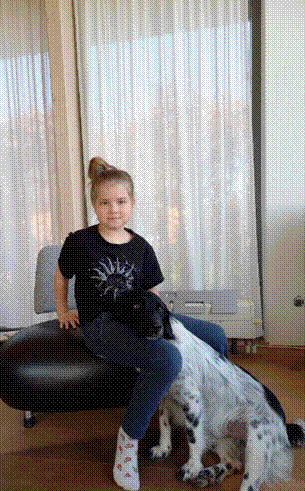
My youngest daughter, Anastasia, and our dog Yuno, who helped her a great deal. The child had completely withdrawn into herself and did not speak at all, but in March 2022 she began talking to Yuno.
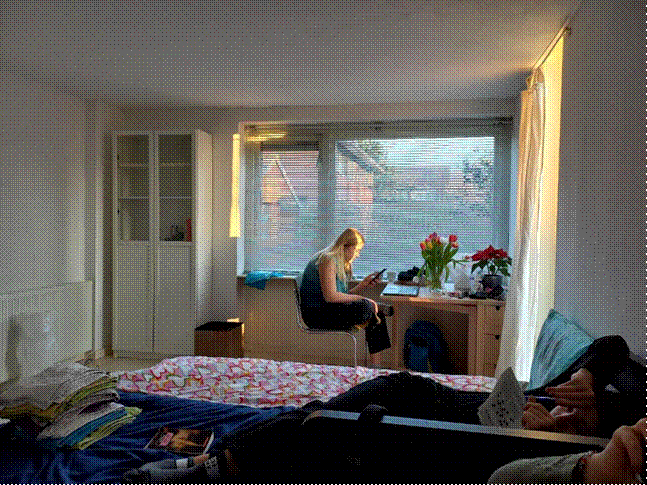
7. Madrid, Academic Year 2022–2023
In April my husband was transferred to Madrid. He, like most of his colleagues, left Belarus, escaping violence and repression. My daughters and I hoped to reunite with him in June, when my temporary teaching contract at the University of Amsterdam would end. I googled the possibilities of a teaching position in Madrid and easily found a one-year Visiting Lecturer position at Carlos III University of Madrid for female lecturers who were refugees from Ukraine and had children. I began to pray daily again, but now these were prayers of gratitude and hope, not prayers of despair as when I feared for the lives of my loved ones.
The bureaucratic machine for transferring a diplomat from Minsk to Madrid was very slow and would take too long; my daughters risked losing their right to education in Spain. In Madrid, we applied for temporary protection, giving up our status in the Netherlands. Maria, who had successfully completed her final year at a Kyiv school, received her diploma. That same Carlos III University, which gave me a job, also offered free places to Ukrainian students on the condition of fluency in Spanish and English and a high GPA. We quickly homologated Maria’s Ukrainian diploma—once again, solidarity with Ukrainians was at work. Maria’s GPA allowed her to enter almost any faculty, except medical and law. That suited both of us. She was extremely nervous, but she passed Spanish at B2 and English at C1. We emailed her educational documents, language exam results, and proof of temporary protection, and applied to three faculties at Carlos III University. At the end of June we received a positive response: Maria was admitted to the Faculty of Anthropology!
With great difficulty, I found a place in a class for foreigners for my youngest, Nastia. She was born in Mexico and lived there until age two but was too young to learn the language. So unlike her sisters, who gained fluency in Spanish thanks to their father’s assignment to Mexico, Nastia did not have that advantage. Moreover, she had dyslexia, which made her very shy. There were only six classes for foreigners in all of vast, multinational Madrid. My middle daughter I placed in a nearby secondary school for grade 10, and she quickly found friends and adapted.
The teaching schedule at Carlos III University was extremely intense.

At the same time, I continued teaching online at Kyiv-Mohyla Academy and ran the Model UN Club. I gave up three of the six courses I taught at Mohylianka. Male colleagues gladly took them over, because by law lecturers with 0.75 teaching load received a deferment from mobilisation.
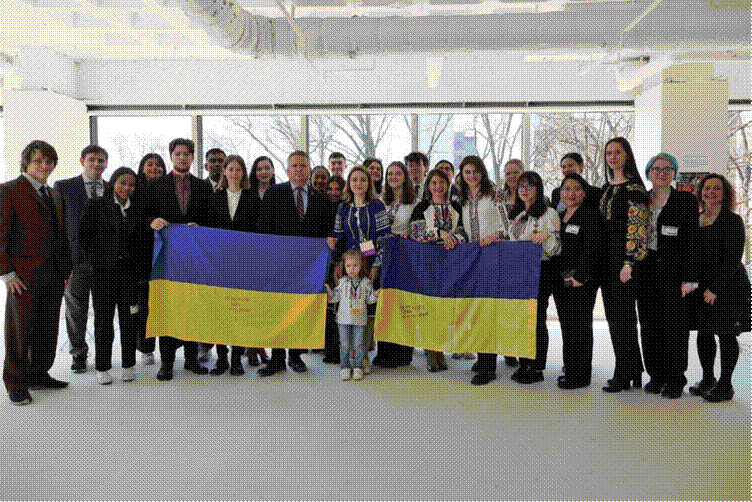
In the 2022–2023 academic year I taught more than five hundred students at both universities. I was able to accompany Ukrainian students to the Model UN in New York during Easter break and speak at several academic conferences.
All this time I worked at the maximum of my abilities, barely making it to the end of the academic year. In the summer of 2023, I suffered a nervous breakdown and professional burnout. I had to seek individual psychological help. It helped somewhat; I tried to slow down and allow myself to rest.
We went with the girls to Kyiv for a month. I saw my parents, my cat; grandparents hugged their granddaughters. When we were all in our Kyiv apartment—right after the Russians blew up the Kakhovka dam—our district came under heavy bombardment. Grandfather, my middle and youngest daughters were asleep, while my mother, Maria, and I sat in the hallway, wondering whether to wake them or not. My mother said it wasn’t necessary. And she asked me to let the girls study without bombardments as long as temporary protection allowed. I promised her I would.
8. Madrid, Academic Year 2023–2024
The grant for refugee lecturers from Ukraine ended, while my husband’s diplomatic posting in Madrid was extended for another year. This time I decided to apply for open lecturer positions in Madrid universities not as a refugee, but on general grounds. I managed to obtain a part-time position at one of Madrid’s most prestigious universities, Universidad Pontificia de Comillas.
To be hired, I had to go through the qualification recognition process. It was very similar to what Maria had gone through before admission: in addition to a school diploma and language exams, I had to validate my bachelor’s, master’s, and PhD diplomas, submit published articles, syllabi of the courses I had developed, and a summary of my dissertation in English. I was nervous—probably in the same way as my entrant Maria had been the year before. But my qualification was recognised, and I am very proud of it!
I had just one course for one group in one semester at Comillas. But I felt confident again and could once more enjoy teaching.

9. The Regeneration Group, May–July 2024
In this mutual support group, two professional psychologists held weekly sessions to help us—teachers and lecturers—overcome war trauma, find inner resources to continue meeting students and pupils, teaching them reading, writing, math, or, in my case, analysing international conflicts and finding ways to resolve them—through diplomacy if possible, or through sanctions or coercion into peace.
The hardest thing professionally after two years of war has been a certain rejection of my choice—teaching at two universities and living in Madrid—by my colleagues. It went so far that all students writing theses under my supervision, during their public defences, were criticised for using the word “conflict” when referring to the Russian invasion. When I tried to discuss this with colleagues, they shouted: “Shame!” One student, who studied both at Mohylianka and at Sciences Po in Paris, was told that she was not a patriot for using the word “conflict”, and that her supervisor was unprofessional.
This hurt me to tears. I never considered my teaching in Amsterdam or Madrid to be some sort of “success story” meant for bragging. On the contrary, I long struggled with “impostor syndrome” and quietly cried at night from joy that—against all odds—it had worked out! My students applauded me! They wrote thoughtful final essays! They wrote me letters of gratitude! And I am deeply, deeply grateful to them. I will not devalue this miracle.
I dearly love my Alma Mater and my workplace—Kyiv-Mohyla Academy. I very much hope that I will still be able to teach both in Madrid in person and at Mohylianka online.
“Who are you?”—our group instructor asked. Everyone answered. I often said I was a mother, and that this gave me strength—to leave Kyiv at the start of the war to save my daughters, to overcome my fear of teaching in English, because I had to support them. But in speaking it all out, I realised I could not reduce myself only to motherhood. To the question “Who are you?” I will answer:
—I am a lecturer, I am a professional, I am a researcher. This is what brings me fulfilment and recognition.
Drones do not fly over me, and my electricity is not cut off. Instead, I must adapt to a new environment, speak not Ukrainian but English and Spanish, talk to my parents only occasionally when they have power, and miss my native city.
“Who are you not?”—the instructor asked.
—I am not a traitor. The fact that I am in Madrid and not in Kyiv is not a betrayal of Ukraine or of our dear students. And yes, any war is a conflict—in its most acute, disgusting phase. Calling me a traitor for not being in Kyiv is to dehumanise me, to destroy me as a professional and as a Ukrainian.
I wish all my colleagues would care for their mental health, speak out their pain, not project it onto someone suddenly deemed “other”, and share it with those they trust—preferably in a group, to see different strategies of coping. We all need this.
We have all lost something in this war. My family so far has lost only lightly—we will never have the apartment by the park we saved for so carefully. Instead, there will be something else.
10. Madrid, Academic Year 2024–2025
My husband’s posting ended, and he returned to Kyiv. At a family council we decided that the girls and I would stay in Madrid to teach and study. Teaching is what I love and know how to do. Perhaps someday one of my Spanish students will become a diplomat and make decisions, remembering their Ukrainian lecturer.
Everything in the world is wondrously interconnected. As I began work at Comillas, I was told that the department was about to open a research program on security challenges to European security in connection with Russia’s aggression against Ukraine, and that I would become an important part of this project. In my free time, I began developing a Spanish-language course in advance, imagining how I would serve Ukraine by telling Spanish-speaking students more about it.
In reality, Trump’s rhetoric about ending the war in 24 hours influenced my university’s research and teaching funding committee to decide that the project was no longer relevant, and it was not funded. Instead, I was offered to teach two more courses and join the EU Peace project, under which—though not in Spanish, but in English—I am still creating a course on security challenges on the European continent in connection with Russia’s invasion of Ukraine.
My “place of strength” and calling—the Department of International Relations at NaUKMA—after discussions and debates, again accepted me not as an “outsider”, but as “one of us”, which filled me with strength and inspiration. I received the position of Associate Professor after publishing the article “From Shock to Adaptation Through National Unity and Action: Third-Year Undergraduate Students of First Eighty Days of Russia’s War Against Ukraine (https://www.ibidem.eu/en/Series/Society-Politics/Soviet-and-Post-Soviet-Politics-and-Society/Teaching-IR-in-Wartime-E-Book.html), which describes the experience of Mohylianka students during the first three months of the war. These were the very students with whom I spoke online in the “Introduction to Conflict Analysis and Peacebuilding” course on the first day of the war. These were the very students who have now completed their master’s degrees at the best universities in the world and Ukraine, and I am glad that I could contribute to their education in the hardest moments of the war. As long as hybrid teaching remains possible, I will continue teaching at Mohylianka online.
My planning horizon cannot extend beyond one academic year—this is what the war has taught me. I very much want to return to Kyiv, but my daughters’ safety comes first. During one of the numerous bombardments of Kyiv in July 2025, a sixteen-year-old girl was killed who had left the city with her family in the first days of the war and returned for the first time to see her grandmother. Every day I am still terribly afraid that Russia will kill my child. More than three years of life in Kyiv have been a daily lottery—whether a Russian bomb will hit your home or not, whether tonight Russia will kill your child or someone else’s. For more than three years, I have done everything in my power to make sure my children survive.
Next academic year I will teach at two universities in parallel—at Comillas in person, and at Mohylianka online. My eldest daughter Maria will start her fourth, final year of undergraduate studies, while my middle one, Sasha, will begin her first year at Carlos III University in the Urban Sustainability program, to which she was admitted this year. Anastasia, just like last year, overcoming her dyslexia, with the minimum passing grade in Spanish, moved from grade 7 to 8—and I simply cried with happiness and pride for her.
Both my daughters and I have learned to find what enriches us even in the darkest of times. I believe I have preserved their wholeness and their faith in the kindness of strangers and in me—as their guide and protector. I see that they are full of energy to study and grow. As for me, who once felt shattered like a cup, I managed to glue myself back together piece by piece. I will never be the same again. But I will always understand the pain, fear, and anger of others—and also the movement toward overcoming, the movement toward light.
Reference
Solovei, G. (2022, March 17). A Ukrainian woman’s story of escaping the war. Korea JoongAng Daily. https://koreajoongangdaily.joins.com/2022/03/17/national/diplomacy/ukraine-russia-kdi/20220317184513707.html