Want to create an effective
e-learning resource? Our design principles and their application in a case
study
Smita Odedra1 and Linnea Soler2
1 University of Glasgow, Glasgow, UK
Abstract
In this work, we describe our approach to creating new e-learning materials. This first required the development a set of design principles followed by working in partnership with our students to create and evaluate the e-resources. These design principles were designed to give the student partner a useful framework within which to work yet, at the same time, providing freedom for inclusion of their personal creativity and authenticity in the resource development. Here we: describe our design principles and rationales for their use; introduce a case study trialling this methodology for course enhancement through the development of an online support resource; and evaluate student feedback on the approach taken. Evaluation data from this case-study shows that this approach has a positive impact on the student learning experience and has generated an appetite from the student body for more e-learning support created using our design approach.
Keywords
e-learning, active learning, staff-student partnership,
e-resource design principles, higher education, SoTL
Background
In response to the Covid-19 pandemic and lockdowns during academic years 2020-21 and 2021-22, we were required to pivot from lectures and lab-based teaching to an online format within a short time scale and with a very limited budget. While this posed many challenges, it also provided us with a unique opportunity to explore new platforms for online learning and to establish the scene for developing new blended e-resources that we still use, post-lockdown, to support in-person classes. In our own context (Chemistry Higher Education (HE)), our motivation to construct engaging, interactive, multimedia-rich virtual teaching resources stemmed from the need to teach practical skills and advanced theory, and our desire to enhance the learning experience of our students. Not only did we require routes to convey visual, hands-on, and theoretical concepts, but these routes also needed to bridge atomic-level details with lab-scale practical activities. We perceived online learning support resources as a potential solution to target existing gaps in the curriculum by helping students to connect knowledge of related topics that can be taught across different classes by different instructors, and sometimes in courses that are years apart from each other. Alongside our objectives for teaching complicated subject materials well and for enhancing student experiences, our academic roles also have the objectives to supervise final year students and to support them in carrying out independent research as part of their degree programme requirements.
A combined solution for these multiple objectives was to involve our BSc project students in the design, creation, and evaluation of new e-resources for the curriculum. This allowed us to simultaneously co-create new teaching resources for undergraduate classes and offer opportunities for BSc students to work in education research and scholarship projects as part of a credit-bearing course. As our student co-creators came from an undergraduate Chemistry background with no prior formal training or experience in education, it was crucial to support them from the outset of the projects to help them make the transition into learning design and educational scholarship. To achieve this, we established a set of design principles to guide our project students as they created new online teaching materials. Our supervision, together with our design principles, resulted in the creation of a useful framework to help our student partners to understand some key theories of learning and how these could be practically implemented in the development of an online teaching resource.
These design principles were influenced both by the theory of cognitivism and by our own extensive experience as educators where we value the social aspects of learning. By giving consideration to how learners process information, we emphasised the importance of structuring our e-resources to the student co-creators. In addition, by centring our knowledge of how teaching and communication approaches can influence learner motivation, coupled with the tenets of social constructivism, we encouraged our student co-creators to use their authentic voices in their outputs to instil a sense of relatability and enjoyment in the learning process.
We hope that our approach described here will be useful to educators wishing to create engaging teaching e-resources, regardless of discipline or education sector level.
Aims
Three interlinked aims frame this work:
i. Establish a design protocol for creating of e-resources;
ii. Create an e-resource as a case study to implement the design principles, including a student as a co-creator;
iii. Evaluate efficacy of the co-created e-resource, including a student as co-researcher, to answer our question: Have our design principles worked?
Literature
Teaching and learning online is not a new concept; HE has leaned into digital transformation since the advent of the World Wide Web (Harasim, 2000). With the proliferation of Virtual Learning Environments (VLEs) by the mid-2000’s, university education since has relied on these online systems for functions beyond simple content repositories, enabling assessments, communications and course administration to shift to the web (McAvinia, 2016). Massive Open Online Courses (MOOCs) have seen a rise in popularity since 2008, providing flexible opportunities for students to learn online (Daniel, 2012; Kaplan & Haenlein, 2016). Since then, a strong focus on technology-enhanced learning and online/blended learning provision in university strategies has led to considerable research in this area. However, this technological shift to e-learning was dramatically accelerated by the Covid-19 pandemic, when large-scale lockdowns prevented students from physically attending classes, and the entire sector rapidly pivoted their degree programmes online as part of an emergency response to the crisis (Ferri et al., 2020; O’Dea & Stern, 2022; Watermeyer et al., 2021). In a post-lockdown world, many classes have returned to campus, although enriched with more online content than ever before.
For educators desiring to host entire modules online or develop blended courses, there are many well-established approaches that can support course development planning, including the ABC Learning Design (Young & Perović, 2016), and Universal Design for Learning (UDL) (Rose & Meyer, 2002). ABC Learning Design centres a collaborative approach to blended online curriculum co-design, allowing teams to quickly create visual storyboards representing sequences of learning activities while integrating assessment plans and institutional policies, and planning which activities take place online or offline (ABC Learning Design @ UCL, n.d.). Meanwhile, UDL (CAST, n.d.) is a framework for learning that centres the importance of accessibility and designing for a wide range of learner needs, aiming to create agency for learners through the provision of multiple means of engagement, representation, and learners’ action and expression. This framework encourages educators to intentionally design materials that reduce barriers to learning, and it can be adapted according to the context and level of teaching.
For educators like us wishing to dabble in creating online course content to support an existing on-campus course, there is no shortage of advice on how best to develop teaching resources to support learners. Many of the principles of UDL can be used on a local level and small scale to improve aspects of teaching, even for educators who do not have control over wider decisions on their students’ entire curriculum. In addition, approaches to online teaching may be influenced by many other evidence-backed studies. Mayer’s theory of multimedia learning (Mayer & Moreno, 2003) underpins much modern learning through application of cognitive load theory to effectively combining media and text, while principles of scaffolding (Doo et al., 2020) ensure that learners have structured support in advancing their knowledge. Chunking ensures content is broken into manageable amounts of information, improving capacity for learning (Fountain & Doyle, 2012), and can be even more powerful when combined with regular opportunities for active learning, appropriate student assessments and aligned feedback. In addition, there has been a rising trend of gamification in learning, showing new ways to increase learner motivation (Gressick & Langston, 2017; Zeybek & Saygı, 2024). Research into the concepts of ‘stickiness’ (Li et al., 2021; Robinson & Cook, 2018) describe how online content developers aim not just to attract users but also sustain user engagement, and this user commitment is influenced by several factors including students’ perceived usefulness and interactivity of online experiences.
However, selecting the relevant concepts for the intended purpose and weaving them together into a cohesive and tangible teaching output can be challenging for educators who are involved in creating resources for online learners. These challenges can be exacerbated for those with limited budgets and perhaps lacking access to central institutional facilities, support, and expertise. How can we create resources that are relevant and engaging for our classes through the adoption of our curated concepts from a wide body of literature? Below, we summarise the design principles we found to be most important when creating our online interactive learning resources. These are the principles we used to guide our student co-creator to help them design and create new e-resources to supplement and support existing courses in our curriculum.
Our design principles and rationale
Our approach to creating e-learning resources was grounded in the consideration of the student user experience and, with concerns of the digital divide, we put accessibility at the core of our plans. We were also aware that students could face a significant amount of passive content in online learning provision during the pandemic, with proliferation of video content and linear slideshows. Key to our rationale was avoiding cognitive overload, as well as promoting student engagement and motivation. Influenced both by the literature on e-learning and our reflections on students' experience in our courses, we devised a set of core principles to guide all our e-resource design. These are presented in Table 1.
Table 1. Our design principles for e-resource creation
|
Principle |
Justification |
Implementation |
|
Interactive |
Enabling active learning is fundamental to improve and maintain student engagement.
|
By including formative quizzes in our resources, with immediate feedback and unlimited opportunities to engage, we provide a safe place for students to learn from mistakes without fear of failure. |
|
Led by student insights |
Students have a full perspective of the curriculum experience and are uniquely placed to offer useful insights in course development. |
We were aware that we needed a good understanding students’ prior knowledge of topics. Adopting a staff-student partnership model gave us further insight into bridging gaps in the curriculum. |
|
Fun and whimsy |
By using an informal tone coupled with elements of fun and whimsy, we aimed to improve student motivation & engagement; reduce stress, anxiety and fear of failure. Additionally, a relaxed tone can enhance relatability. |
While style and use of language was key to achieving the right tone, we also used memes and gifs as feedback (Soler & Odedra, 2021). The staff-student partnership model was vital to striking balance and choosing relevant pop culture references that would appeal to the wider cohort of students. |
|
Bespoke touches |
While many ed-tech companies sell ‘off-the-shelf’ solutions for teaching content across the disciplines, we create our own multimedia, rooted in our own teaching spaces, and featuring members of our own campus community. |
We include customised media (including photos and videos) to provide a sense of connection to our campus. Not only was important during remote teaching to give students a flavour of our institution, but it continues to be vital in blended learning to enhance familiarisation of our students with our campus and facilities, e.g. for induction and training purposes. |
|
Self-led exploration |
By leveraging interactive navigation options, we aim to encourage independent learning based on the needs of the individual learner. More material is found, as needed, embedded in clickable layers in the resource. |
Non-linear navigation in Genially allows users to explore content based on their own needs e.g. to access extra information to revise concepts and find extra hints to scaffold learning through problems. solving. This also allows for easily revisiting parts of the resource as needed. |
|
Gamification |
Elements of gamification can increase user motivation and activity completion rates. |
Gamified elements of learning can be embedded using quizzes, graphics and creative ways of giving students feedback. |
|
User experience |
Ease of access on different devices and stability is important for users. Creating visual appeal promotes sustained engagement. |
Genially provides a stable platform to easily create HTML5 resources that can be accessed on different devices. It also has a variety of templates which provide a quick way to create visual appeal. |
|
Plain English |
Concise language makes our resources easy to understand, benefiting students whose first language is not English, reducing barriers to participation and making resources more inclusive. |
Using a staff-student partnership model was important to bring student voice on board and ensure the language and content used in resources was appropriate. While it is important to use technical language to accurately convey concepts, students can help pitch the level appropriately so that text makes sense in the context of what their year group has learnt so far. |
|
Chunking |
By deconstructing complex topics into smaller, digestible chunks we have aimed to make learning more manageable. Thoughtful use of content to avoid overwhelming students aims to reduce sensory load and increase accessibility. |
Genially resources can be built up in many layers. As well as breaking topics apart by pages (like a simple slideshow), content can be placed in interactive pop-up boxes. This allows information to be arranged in smaller chunks and increases user control in navigating information at their own pace. |
Staff-student partnership model
Using a staff-student co-creation approach allowed for the inclusion of the student voice in course enhancements, thereby enhancing authenticity and relatability for many members of the class. For this case study shared below, our final-year project student took part in this research as part of a credit-bearing undergraduate course. As supervisors, we helped our student to: establish the overall aims and structure of the desired teaching e-resource: understand the principles of cognitive load theory and other studies underpinning the research; and reflect on his own learning experience of the curriculum. We led on the ethics application and guided the evaluation plan for researching the efficacy of the output. The student took the lead in creating content for the resource, with the overall style guided by our design principles. The project student’s chosen chemistry content was influenced by their own research on the topic and was guided by their perspective of their own recent first-person learning in the degree curriculum. Additionally, the student analysed the evaluation data as part of their dissertation and has been actively involved in external dissemination of the work (Tsui et al., 2022).
This approach of collaborating with a single student is a requisite artefact of our final-year project structure which limits the number of students directly involved in the project at a single time. Involvement of a single student may have limitations in representing the entire cohort; however, they can still add valuable diversity of contributions in a curriculum which is usually dominated by staff perspectives. Alternative models of student-staff partnership could involve consultation with a wider range of stakeholders and student communities to help inform the overall output. We would recommend broader input when planning major changes to courses or the curriculum.
Web application software
Our goal was to create an interactive e-resource with layers of different types of media, with intuitive navigation and linkages to allow for self-led exploration of topics and not be limited to a linear path through our learning material. This layering of information was intended to reduce the risk of cognitive overload, since content could be built-up in smaller, interactive chunks. We needed flexibility to enable creative design and to produce a visually appealing and engaging product. It was essential that the platform was easy to use for the novice creators (academics and student partners), with no specialised web-design skills required, owing to time restraints of our project. Additionally, to avoid exacerbating the digital divide, it needed to be accessible without the aid of powerful computers, specialist technologies, or fast internet speeds. These considerations also ensured that our student collaborator could build his e-resource remotely on a standard laptop without requiring extra software or hardware.
Therefore, Genially, a web-based media creation platform, was our tool of choice because it supports most of our design principles (Table 1) and allows for both creation and hosting of HTML5 material. Because it is a web-based platform, no specialist apps are needed to access the content, apart from a web browser, and content can be made publicly accessible. In addition, Genially is compatible with screen readers and allows keyboard navigation, ensuring that some fundamental accessibility goals are met (Genially Support, n.d.). Our choice to use this also considers the user experience of other staff members. Simply by sharing a link, other educators can use the e-resource for their classes without further complications or stress.
Case Study: Trialling our approach
Project details and data collection
This case study is based on work carried out with a final-year Chemistry BSc student, Hoi Fong Tsui (HFT), who carried out work as part of his undergraduate research project (2021-2022).
HFT was guided through our design principles and tasked with independently creating an online resource aimed at Chemistry students, suitable for all levels of undergraduate study. HFT chose the style and created an e-resource with his personal flair. The resource was intended to supplement in-person classes to help students understand a commonly used practical technique in chemistry (chromatography). The intention was to fill a gap in curriculum where the theory of the topic is not covered in detail either in lectures or laboratory classes. The e-resource was introduced as an optional, non-assessed addition to the course, embedded in our VLE. Figure 1 shows two screenshots of the interactive resource created by HFT.
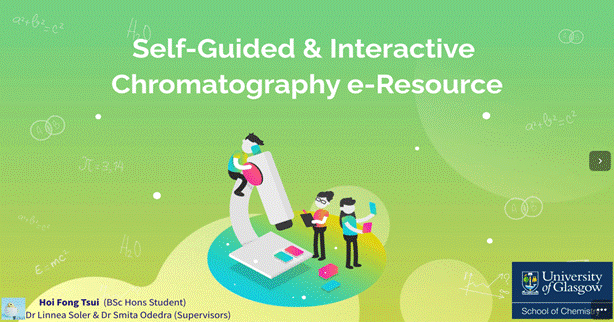
Figure 1a. HFT’s e-resource for chromatography showing screenshot of Landing Page.
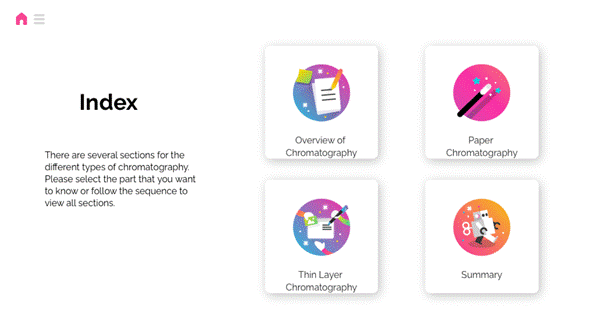
Figure 1b. HFT’s e-resource for chromatography showing screenshot of the Index Page.
A mixed-methods approach was then used to assess the efficacy of the e-resource, employing an anonymous online form to collect student feedback through both five-point Likert-style and open-ended questions. Ethics approval was granted for data collection. The survey was provided to participants via a link embedded in the e-resource, and the e-resource was shared with our upper-level chemistry students. Participation was purely voluntary, with no engagement incentives offered. N = 11 students from Levels 3 and 4 participated. While the sample size is relatively small (reflecting the optional nature of engagement with the resource), results still provide a useful range of insights into student opinions of the resource.
Results and evaluation
Both qualitative and quantitative data were collected to explore the student participants' experience of the e-resource. These responses have allowed us to understand the benefits of our approach, as well as its limitations, and provide ideas for future improvements.
The design aspects of the e-resource were explored using Likert-style questions (Figure 2). The overall responses were mostly positive (“liked”) or extremely positive (“loved”), with some “neutral” and negative (“disliked”) responses recorded in two sub-topics. Noticeably, there were no “loathed” responses, meaning that our participants did not express any strong dislike to any of the design principles.
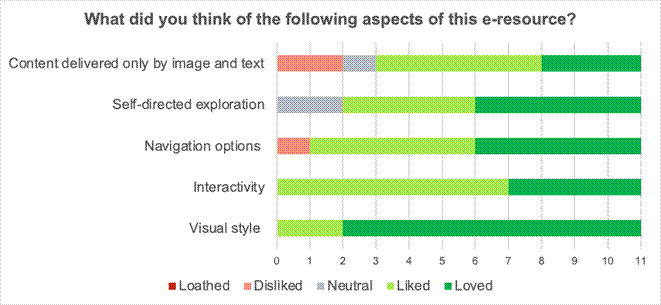
Figure 2. Overview of participants' perceptions of the e-resource.
Students appreciated the interactivity and non-linear choice-based (“self-directed”) navigation options. In open-ended questions, this was noted as being particularly helpful, with one student commenting “Interactivity and navigation were very useful and different images made it easy to follow”.
There is also evidence that the visual style was effective, with one student stating that “User interface/aesthetic, made the material enjoyable and less intimidating”. This suggests that the relatable student-influenced style and tone of the materials helped to reduce the fear factor around learning new concepts and have a positive impact on student engagement and affective domains.
Chunking and scaffolding were successful in reducing cognitive load; students appreciated the breakdown of information into manageable portions provided by the layering approach of Genially:
It was clear, concise and visually pleasing. If I was to use this before a chromatography lab I would find it very useful. I liked the ability to gain more information from clicking around the page rather than it all being shown and be overwhelming on the page. I found the pictures with short, snappy explanations were the easiest to understand.
This finding ties in well with literature and confirms that our implementation of this strategy was effective.
A small number of users found difficulty navigating the resource. This highlights the importance of designing the overall structure of e-resources and planning how different sections of content should link together with well sign-posted guidance incorporated.
Two users expressed dislike for the fact that delivery of the materials in the e-resources was done using only text and images. In future, more diverse forms of multimedia elements could be introduced to an e-resource like this, including videos and quizzes, to provide more routes for sharing content.
The impact of the design principles through the exploration of user experience is summarised in Figure 3.
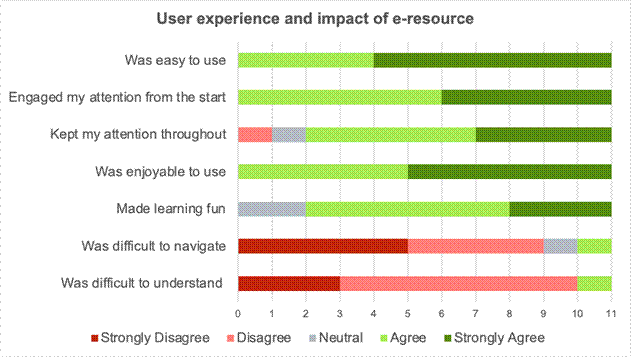
Figure 3. Overview of participants' perceptions of the e-resource.
These results reveal that not only did the e-resource engage users’ attention immediately, but also that, for most users, this high level of attention was maintained for the duration of use of the e-resource, providing some evidence of stickiness in the content. Notably, nine out of the 11 respondents either agreed or strongly agreed that the resource made learning fun. Considering the inherently challenging nature of the topic itself, this was an encouraging result, demonstrating the power of non-traditional methods for teaching and how effective an informal tone and including elements of whimsy can be for making learning enjoyable.
The questionnaire also revealed that there is a strong appetite for development of more e-learning support resources like this in future (Figure 4).
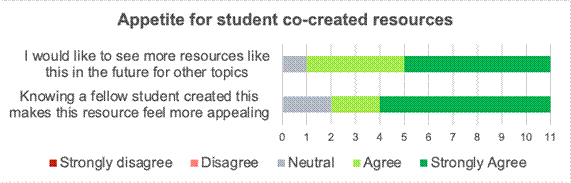
Figure 4. Student appetite for this style of e-resource.
In addition, nine out of 11 respondents felt that the student involvement in the resource development made it more appealing. This is a strongly encouraging result that highlights the benefits of peer-to-peer teaching via online delivery modes.
These results represent the views of students who purposely selected to engage in an optional learning task aligned with their curriculum, and these participants may be more positive compared to the general class population. Nonetheless, the responses are insightful and help to understand how our design principles can potentially increase learner motivation, engagement, and enjoyment.
Conclusions
We have successfully met our overarching aims by: (i) establishing our personal design principles, underpinned both by pedagogy and our own experience as educators; (ii) creating a viable e-resource by incorporating our design principles together with our student collaborator (HFT) as a case study, and; (iii) evaluating this e-resource and learning that the participants were overwhelmingly positive about the utility and efficacy the e-resource. Our approach was effective in delivering demanding scientific content, with every student participant strongly agreeing that they would like to see more e-resources like this in the future for other topics. Our student-staff partnership approach infused the e-resource with relatable content, designed and structured to lead and to support student learners from the perspective of a student and using the project student's voice to communicate. We have since co-created even more e-resources with students, including compulsory curriculum components, using this same approach. Preliminary analysis of evaluation data from subsequent projects further supports our findings from this case study and demonstrates the effectiveness of our design principles for improving student motivation in blended learning activities. We are confident that this approach is highly effective and will be used in other staff-student projects to create more e-resources to support our student learners, and we recommend that others consider adopting this route to creating engaging learning e-units guided by these design principles.
References
ABC Learning Design @ UCL. (n.d.). https://blogs.ucl.ac.uk/abc-ld/
CAST. (n.d.). The UDL Guidelines. https://udlguidelines.cast.org
Daniel, J. (2012). Making Sense of MOOCs: Musings in a Maze of Myth, Paradox and Possibility. Journal of Interactive Media in Education, 3(3). https://doi.org/10.5334/2012-18
Doo, M. Y., Bonk, C., & Heo, H. (2020). A meta-analysis of scaffolding effects in online learning in higher education. The International Review of Research in Open and Distributed Learning, 21(3), 60–80. https://doi.org/10.19173/irrodl.v21i3.4638
Ferri, F., Grifoni, P., & Guzzo, T. (2020). Online learning and emergency remote teaching: Opportunities and challenges in emergency situations. Societies, 10(4), Article 4. https://doi.org/10.3390/soc10040086
Fountain, S. B., & Doyle, K. E. (2012). Learning by chunking. In N. M. Seel (Ed.), Encyclopedia of the Sciences of Learning (pp. 1814–1817). Springer US. https://doi.org/10.1007/978-1-4419-1428-6_1042
Genially Support. (n.d.). Genially and accessibility. https://help.genially.com/en_us/genially-and-accessibility-SJu3jPr3i
Gressick, J., & Langston, J. B. (2017). The guilded classroom: Using gamification to engage and motivate undergraduates. Journal of the Scholarship of Teaching and Learning, 17(3), Article 3. https://doi.org/10.14434/v17i3.22119
Harasim, L. (2000). Shift happens: Online education as a new paradigm in learning. The Internet and Higher Education, 3(1), 41–61. https://doi.org/10.1016/S1096-7516(00)00032-4
Kaplan, A. M., & Haenlein, M. (2016). Higher education and the digital revolution: About MOOCs, SPOCs, social media, and the Cookie Monster. Business Horizons, 59(4), 441–450. https://doi.org/10.1016/j.bushor.2016.03.008
Li, A., Islam, A. Y. M. A., & Gu, X. (2021). Factors engaging college students in online learning: An Investigation of learning stickiness. Sage Open, 11(4), 21582440211059181. https://doi.org/10.1177/21582440211059181
Mayer, R. E., & Moreno, R. (2003). Nine ways to reduce cognitive load in multimedia learning. Educational Psychologist, 38(1), 43–52. https://doi.org/10.1207/S15326985EP3801_6
McAvinia, C. (2016). Enter the VLE. In online learning and its users. In Online learning and its users: Lessons for higher education (pp. 11–34). Elsevier. https://doi.org/10.1016/B978-0-08-100626-9.00001-0
O’Dea, X. (Christine), & Stern, J. (2022). Virtually the same?: Online higher education in the post Covid‐19 era. British Journal of Educational Technology, 53(3), 437–442. https://doi.org/10.1111/bjet.13211
Robinson, A., & Cook, D. (2018). “Stickiness”: Gauging students’ attention to online learning activities. Information and Learning Sciences, 119(7–8), 460–468. https://doi.org/10.1108/ILS-03-2018-0014
Rose, D. H., & Meyer, A. (2002). Teaching every student in the digital age: Universal design for learning. ASCD.
Soler, L., & Odedra, S. (2021). The magical effect of memes and gifs for feedback. In N. Tasler, R. E. O’Brien, & A. Spiers (Eds.), Being creative in the face of adversity—Annual creativeHE collection 2021 (pp. 139–143). Creativity for Learning in Higher Education Community (#CreativeHE). https://doi.org/10.25416/NTR.17709860.v4
Tsui, H. F., Soler, L., & Odedra, S. (2022, March 29). Fostering learning, engagement & critical thinking skills: A student created interactive HTML5 resource [Poster]. 15th Annual University of Glasgow Learning and Teaching Conference. https://www.gla.ac.uk/myglasgow/add/events/pastconferencewebpages/2022learningandteachingconference/posters/
Watermeyer, R., Crick, T., Knight, C., & Goodall, J. (2021). COVID-19 and digital disruption in UK universities: Afflictions and affordances of emergency online migration. Higher Education, 81(3), 623–641. https://doi.org/10.1007/s10734-020-00561-y
Young, C., & Perović, N. (2016). Rapid and creative course design: As easy as ABC? Procedia - Social and Behavioral Sciences, 228, 390-395. http://dx.doi.org/10.1016/j.sbspro.2016.07.058
Zeybek, N., & Saygı, E. (2024). Gamification in education: Why, where, when, and how?—A systematic review. Games and Culture, 19(2), 237–264. https://doi.org/10.1177/15554120231158625