An analysis of science communication courses in the UK for the development of physics students
Thomas D. Lindsay1, Edward A. Breeds1 and Ian C. Whittaker1
1 Nottingham Trent University, Nottingham, UK
Abstract
This review examines science communication courses and modules typically delivered within the UK. While this type of course is generally offered at undergraduate study, the material and techniques presented can be used at any educational level. The taught content and different methods of assessment both formative and summative are discussed. The main results obtained were that, while ‘science communication’ is not a common module in higher education, those sessions that are available often focus on modern media technologies such as podcasts, as well as assessment by portfolio. All university level courses provided opportunities for students to participate in public outreach, although these range in duration between short- and long-term projects. Suggested content for a course, based on common curricula are provided as a resource for teachers in any science discipline to be able to plan essential skills-based sessions with appropriate delivery and assessment methods. The effect of applying this resource to a module within the authors discipline is provided showing a small increase in final grade with a small drop in grade distribution. Student feedback shows an average satisfaction response greater than 80% using these concepts.
Keywords
science communication, key skills, engagement, undergraduate
Introduction
Science communication is one of the key skills of any STEM student or employee (White Rose Industrial Physics Academy, 2022), as well as being an expectation at later stages of education. The importance of communication in scientific roles was clearly highlighted in a labour market report produced for the Institute of Physics (2022) by Emsi Burning Glass (now Lighthouse). Figure 1 is an employment skills demand density graph reproduced from this report. Of the nine employment sectors, communication was the most demanded skill in eight of them, and in third place for the other, out of 15 relevant transferrable skills.
Currently there is no clearly agreed upon definition of science communication, and some examples of how the term is used are listed below:
“Communication of complex information to both specialist and general audiences is needed to tackle global challenges which cover diverse topics.” (QAA, 2019)
“Science communication,” to me, includes professional communication among scientists, so it includes journal publications, issues associated with peer review and open access, conference presentations, writing good abstracts, and so on. PCST is specifically about public communication of science and technology”. (Lewenstein, 2022)
“Science communication (SciCom) is defined as the use of appropriate skills, media, activities, and dialogue to produce one or more of the following personal responses to science: Awareness, Enjoyment, Interest, Opinion-forming, and understanding”. (Burns et al., 2016)
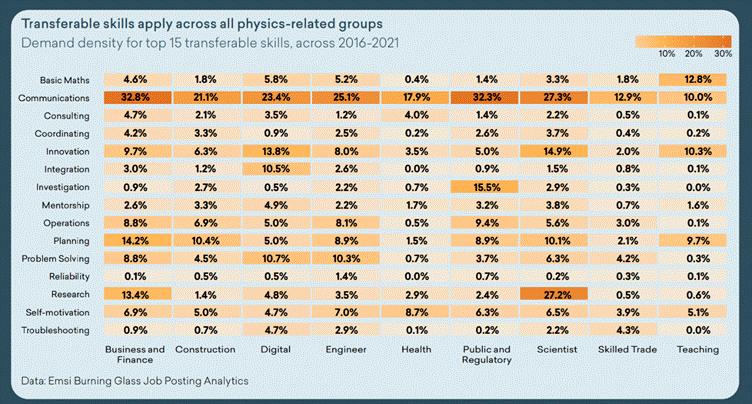
Figure 1. A transferable skills demand density table taken from the Physics in Demand: the Labour Market for Physics Skills in the UK and Ireland report of 2022. Communication (row 2) is the most demanded skill across 8 of the 9 employment sectors. Showing how important it is that graduates have the ability to communicate clearly, honestly, and effectively (IoP, 2022). Source: Lightcast (formerly Emsi Burning Glass).
For the purposes of this study communication between researchers, peers, and public engagement are all considered “science communication” and it will be treated as an umbrella term. This allows the essential parts to be determined while leaving room for personal preference on other aspects of science communication.
The application and benefits of science communication are as varied as the definitions are. In higher education the traditional methods of assessment were (and sometimes still are) exams. While there are many valid and application-based approaches to exams, the core requirement to passing is learning, memorisation, and repeating.
To ensure highly skilled graduates capable of empowering themselves within the workplace they need to be faced with challenge and application outside of the standard classroom approach. Learning and repeating information is simply not enough, and while communication of analysis demonstrates understanding it is important it is delivered at an appropriate audience level. Consider a job interview, a science graduate is unlikely to be interviewed by somebody with the same knowledge and skill sets unless it is a very specialised job. Equally becoming a line manager requires the ability to communicate at a different academic level. Delivering an appropriate conference talk that is effective, writing a grant application, working with a legal team on a patent – these are all rarely considered examples of how science communication benefits learners. The more common examples are the public communication aspect, including outreach events, skills for becoming a teacher, and being able to explain why the curriculum is important to their family members.
This leads to a discussion between the importance of “communication” and “science communication” skills and their differences. Looking back at the UK in lockdown during 2020 the need for science communication has never been clearer. The weekly graphs of infection rates on plots difficult for academics to understand let alone the general public with a droning voice punctuated by “next slide”, generated a lot of memes and organisational response on the poor quality (Freeguard, 2020). This is just a single example and highlights the difference between communication and science communication. The topics involved generally have a lower initial understanding level to the audience and the evidence for any statement is likely to come in the form of data, rather than emotion, feelings, or debate.
This disconnect between audience level and delivery is not just limited to scientists and the public. An example from the authors experience is physics papers written about how magnetosense works in the eyes of birds intended for biologists/zoologists to read (e.g. Kattnig, 2017; Schulten et al., 1978). They tend to have pages of quantum mechanics equations throughout, that only the most dedicated mathematical biologist could start to decipher. This is also true in reverse with multiple bioscience-based papers which have not understood the mathematics and are heavily entrenched in acronyms, jargon, and assumptions meaning that nobody outside of the field can understand the papers (e.g., Fracchiolla et al., 2020). This means that science communication is essential for interdisciplinary projects to succeed.
The importance of science communication cannot be understated for students and society in general. There are publications on the psychology of how to communicate science to a single individual (de Bruine & Bostrom, 2013; Fischhoff, 2013) and building communication skills during physics teaching (Saldo & Walag, 2020; Yulianti & Handayani, 2021). However, there is no clear guidance on what content should be delivered to students or deliver it effectively when training them to communicate with a varied range of audiences, particularly in STEM subjects. This environmental scan of programs in the UK was proposed to search for how science communication modules and courses are currently being delivered in higher education across the United Kingdom. The aim of which is to collate this information, with consideration of relevant modern teaching strategies that could be shared amongst science teacher communities of all levels, not just those in higher education.
Data collection
The UK universities included for consideration were chosen because of accessibility to a good quality of available information, and were University of Glasgow (2019), University of Warwick (2024), University of Cambridge (2022), University of Sheffield (2024), University of Bristol (2024), University College London (2023), The University of Edinburgh (2024), and Imperial College London (2024).
Data were collected by investigation of STEM school and departmental websites. The key feature is that the sites need to have their module titles, module descriptions, and assessment structures available on their website to access. Many universities did not present their content or student assessment methods, so if their departments run a science communication module or lecture it is unknown. All data presented on the webpage was noted down and the useful information was highlighted to compare the different attributes of all the courses and modules.
A particular emphasis was placed on the relevance within the content of the use of digital communication and social media. This links to the idea that science delivery and education has had to change with the increase in social media consumption (Höttecke & Allchin, 2020).
Study results
Attributes covering curriculum content and assessment types have been taken from the information collected online and collated. These attributes show two common attributes have been defined as “core” to a science communication module.
Digital Skills are a necessary part of employability for students at all levels (Suarta & Suwintana, 2021) and these encourage a “significant and strong positive attitude” towards the subject material (Soh et al., 2010). Even brief digital skills training has shown “an increase in desirable learning behaviours” such as planning, resource monitoring, and self-regulated learning principles (Bernacki et al., 2020). Indicative examples of included digital skills for science communication are graphical accuracy, clear and accessible tables, program simulations, and PowerPoint presentations.
Professional practice provides students with knowledge of how they should present their work for both the scientific community and the public.
These core attributes are generally developed during seminar or tutorial sessions at undergraduate level and are regularly required as part of subject benchmark statements or degree accreditation from professional bodies.
There are nine more attributes in addition to the two core attributes which have been reviewed, the first six are relatively common amongst all courses examined and these are: Modern Media, Article writing and reflection, Misinformation, Outreach, presentations, and portfolios. The final three attributes were less commonly found, these were: Interviews and debates, public behaviour, and AI use. Each attribute is covered below with the relevance to science communication. Table 1 shows how many university courses implemented each attribute.
3.1 Modern media in science communication
Six of the universities (75%) were using modern media formats for examples of science communication. The majority of them contain assessment structures that require students to produce their own piece of digital media. The production or inclusion of a podcast or radio show was most common. This is unsurprising as inclusion of short form content to communicate science has relevance to both students and public influence (Qin et al., 2022).
3.2 Article writing and critical reflections
All universities had article writing as a key aspect of their assessment structure in modern formats. There are two typical topics for these articles. The first being an article based on the student’s discipline (63% n=5/8), and the second being an article where the goal is to challenge public misconceptions of science (i.e. conspiracy theories or similar, 75% n=6/8).
Those students on full courses would be required to write both types of article, whereas those on a module would only be required to write one of these types.
All universities included a form of critical reflection linked to the article writing process. The emphasis on reflection varied with course, with 38% (n=3/8) having one reflective piece and the others (n=5/8) containing two or more reflective pieces. Surprisingly, the number of reflective tasks did not correlate with the duration or type of course. These reflections are described as being part of portfolios or simply assessed formatively.
3.3 Tackling misinformation
Challenging misconceptions is taught in 63% (n=5/8) of the universities, focusing on a core knowledge of how to clearly communicate why particular theories are incorrect. Media misconception covers 88% (n=7/8) of the universities and provides students with strategies to avoid the media misrepresenting their work. Teaching students about misinformation has benefits linking to critical thinking, subject enjoyment, and a wider understanding of audiences outside of the academic sphere (Whittaker & Hough, 2025).
3.4 Student outreach
Scientific outreach is a term that is subjectively defined by most, but Tillinghast et al. described it as delivering content outside of the traditional classroom to STEM stakeholders to support understanding, awareness, and interest (Tillinghast et al., 2020).
This outreach is a major aspect of communicating science. All universities included it in some aspect, either going into schools to provide events or producing media. Short outreach periods of up to three days are used by 63% (n=5/8) of the universities. This type of activity would typically comprise a school visit to demonstrate an experiment or having a stand at a science fair. One university both a short period outreach event and a long period outreach activity. Therse longer term activities could be more extensive school visits such as a once-a-week activities which scaffold learning each session or continuing experiments. It could also be a public engagement seminar series or working with a charity partner to enhance knowledge and engagement. Optional longer term outreach activities were available in three of the institutions in addition to the required learning.
3.5 Presentations
To be able to communicate science effectively to peers within science, scientists are required to present their data in front of others as a QAA physics requirement (QAA, 2019). This is likely the reason why 88% (n=7/8) of the universities include formative assessment for presentations tailored to an audience of academics and peers.
3.6 Portfolios
A key ability for a student to show that they can complete a program of work is to have a portfolio of accomplishments (Slater, 1996). Of the universities reviewed 88% (n=7/8) have one of their assessments as a portfolio element, which shows the progress of the student throughout the year and allows them to reflect on their experiences.
3.7 Mock interviews and debates
Debates are an element of communication that are not included in many courses. Only 38% (n=3/8) include debates within their content. Debating skills develop key communication skills and produces empathetic learners who are more likely to gain an understanding of potential misconceptions (Chinn et al., 2020).
The universities that do include debating also include mock media interviews. This correlates well with the idea that a scientist being interviewed is likely to be doing so to settle a public issue, rather than a promotional piece. These can provide crucial experience (Anaza et al., 2023) for students who are more introverted to get an experience of how an interviewer, either from the media or an employer may interact with them.
3.8 Content: Public behaviour
The ability of the public to understand the implications of scientific information is also included at three universities. Public behaviour links to knowing the intended audience, and the inherent scientific capital of the population. Public behaviour in this setting can present as extreme online reactions due to poor communication such as the confidence in a result (Gustafson & Rice, 2020) but could equally include the unintended psychological responses from the general public to scientific information. An example of this with the COVID pandemic was the information of covering mouths and noses to avoid spread of the virus. This resulted in a slight increase in use of tissues and toilet paper, as standard market practice in stores is to keep only a limited amount of stock in store and ordered as needed, panic buying occurred. This in turn led to bulk buying and hoarding of toilet paper globally when there was no reduction in production of the material. This allows students to consider how scientific information can lead to completely unintended consequences and recount their own experiences, providing higher engagement rates and enhancing the individual student identity (Fracchiolla et al., 2020).
3.9 Use of artificial intelligence
At one university, AI is used to help produce attention grabbing aspects i.e. artwork. The empowerment of students to use AI to benefit their outputs, either with altering titles, making artwork, or just improving the accessibility of their work is a positive factor in preparing students for media engagement (Hassani & Silva, 2023; Yeadon & Hardy, 2024).
Table 1. A comparison of attributes on science communications courses at universities around the UK.
|
|
University |
|||||||
|
Attribute |
1 |
2 |
3 |
4 |
5 |
6 |
7 |
8 |
|
Modern Media |
✓ |
|
✓ |
✓ |
✓ |
|
✓ |
✓ |
|
Discipline specific articles |
✓ |
|
✓ |
|
✓ |
|
✓ |
✓ |
|
Article writing on misinformation |
✓ |
✓ |
✓ |
✓ |
|
✓ |
✓ |
|
|
One reflection |
✓ |
✓ |
✓ |
✓ |
✓ |
✓ |
✓ |
✓ |
|
Two + reflections |
|
|
✓ |
✓ |
|
✓ |
✓ |
✓ |
|
Short outreach |
✓ |
|
✓ |
|
|
✓ |
✓ |
✓ |
|
Long outreach |
|
✓ |
✓ |
✓ |
✓ |
|
|
|
|
Presentations |
✓ |
✓ |
✓ |
✓ |
✓ |
✓ |
✓ |
|
|
Mock interview |
|
|
|
✓ |
|
✓ |
|
✓ |
|
Portfolio |
|
✓ |
✓ |
✓ |
✓ |
✓ |
✓ |
✓ |
|
Public misconceptions |
|
✓ |
✓ |
✓ |
✓ |
✓ |
|
|
|
Media misconceptions |
✓ |
✓ |
✓ |
✓ |
✓ |
✓ |
|
✓ |
|
Public behaviour |
✓ |
✓ |
|
|
|
|
|
✓ |
|
Policies and Practice |
✓ |
✓ |
✓ |
✓ |
✓ |
✓ |
✓ |
✓ |
|
Digital Skills |
✓ |
✓ |
✓ |
✓ |
✓ |
✓ |
✓ |
✓ |
|
AI prompts |
|
|
|
✓ |
|
|
|
|

Figure 2. a) an illustration of the eleven attributes of a science communication module found across undergraduate courses in the UK ranked by commonality. Each attribute has been given a short code. b) An example module plan implementing all attributes, this was delivered in the 2024/2025 academic year at NTU.
Discussion
What should a science communication course contain?
Eleven attributes of a UK science communication course have been identified, two core, six commonalities, and three less common. The inclusion of podcasts and short form content is practical as a method of formative or summative assessment. These can be consumed passively or in short bursts and so are able to get across information more effectively. Students would be expected to produce this short form media content within an assessed portfolio within the module. The effectiveness of this type of media assessment will depend on the level of digital literacy that students have and should be provided via workshops within the sessions or linked background material.
Outreach is an essential part of all communication courses. The types of outreach will largely depend on the area, time, and student availability but can be anything from a short session to school visits, science fairs, or working with external partners on a longer-term project. Outreach should be treated in a similar way to work placements; both use common skill sets of application of learning into a different environment. As such the quality of the outreach session is more important than the duration (Smith et al., 2019).
The other key factors in the curriculum for science communication is that of presentation writing and skills, the ability to write for a range of audiences, and being able to reflect on their own work. Key examples of reflection in this context will benefit from peer formative assessment for time efficiency within the session (Dutta et al., 2022).
Investigation of the novel aspects of each course provide a varied set of learning outcomes that could be included in longer running science communication sessions. The relative importance of each of these are largely subjective but the authors suggest that the debating skills and use of AI are becoming increasingly relevant for students’ future careers. The Institute of Physics community perspective document on AI shows that 66% of respondent members use AI, with 44% using AI as a core skill of their job (IOP, 2025). These skills also produce much more accessible communication pieces with a knowledge of ethical use of media.
Figure 2a illustrates these factors in a hierarchy of importance. These have been categorised by commonality into “Core”, “Recommended”, and “Optional”. For ease of reference these have all been given a code of C, R, or O and a number as shown in the figure.
Using the guidance in practice
All eleven attributes described in Section 3 have been applied to a refreshed interdisciplinary module at NTU for level 7 Physics and Biosciences students called “Science Communication”. This allows the authors to show the guidance in practice and how it is received by students. This optional module in the 2024/2025 academic year contains 19 students (14 in physics and 5 within biosciences), some are on a final year integrated master’s course while others are doing a separate MSc or MRes degree. The topics of the contact hours as part of the module are provided in Figure 2b and each attribute relevant to the session from Figure 2a is included as a column.
The refreshed module contains three assessments comprising a public science article, a podcast, and a portfolio of reflections. Reflections covered: their group science outreach experience with an external charity partner, the skills gained in the module, AI use in ethical outreach, and challenges of writing to an appropriate audience level. This years cohort averaged 71.7% (s.d. = 13.0) on the module, with the public science article scoring an average of 72.2% (s.d. = 16.4), the podcast scoring 75.1% (s.d. = 14.7), and the reflection scoring 63.9% (s.d. = 25.9). The reflection portfolio is where most students struggled and had the widest disparity in grades. This is likely due to reflection being a seldom used skill in undergraduate STEM and is now being considered for introduction at an earlier stage (e.g. level 4) to improve student agility and resilience.
These module scores can be directly compared to results from the 23/24 academic year which used a more didactic and static delivery. N = 31 (24 physics and 7 biosciences), the final grade was 69% with an s.d. of 15.9. The public science article which is the same assessment scored 67% with an s.d. of 17.5. The other two assessments were a blog and a skills discussion and do not directly relate to this year’s assessments.
Delivery of this refreshed communication module to include the modal components from other science communication courses has not shown a dramatic increase (i.e. not statistically significant) but does show a very small increase in grades with less of a dispersion of grades suggesting it does no harm for those already doing well but helps those getting the lowest grades.
The 24/25 delivered module was the first to have a student feedback threshold reached (55% minimum) which allowed the NTU standard report to be generated with the following Likert scores.
· I have a good understanding of the module content: 4.6/5
· There is an appropriate mix of small group and class discussion and I have felt able to contribute to this: 4.6/5
· I understand how I will be assessed on this module: 4.3/5
· It is obvious to me which transferable skills I am developing: 4.5/5
Without an equivalent report for the 23/24 academic year due to low feedback response these cannot be directly compared but show a positive view from the students on their learning. Informal feedback was received from students within sessions and as part of the portfolio reflections which are planned to be used to enhance the module for 25/26 when level 7 mathematics MSc students will also be invited to take the module.
Conclusion
An overview of the key attributes of a science communication curriculum does not currently exist. this review looks at common features amongst those taught in the UK in higher education. This is to allow any educator wanting to write a new lesson, lecture, workshop, module, or even whole course to have a starting point for developing lecture and workshop materials.
There are eleven elements determined across taught modules, these are shown in Figure 2 and are split by Core, Recommended, and Optional.
· Digital skills
· Professional practice
· Modern Media
· Article writing and reflection
· Tackling misinformation
· Student outreach
· Presentations
· Portfolio assessment of communication pieces
· Interviews and debating
· Public behaviour
· Ethical AI use
The use of these attributes has been applied to a refreshed postgraduate module in science communication for interdisciplinary delivery. The results showed an increase in final grade with a decrease in spread of grades and positive responses in student feedback. These attributes and example module delivery topics are provided to facilitate the delivery of science communication in concert with any educator’s personal teaching philosophy and pedagogical style.
Acknowledgements
Thomas Lindsay was funded by an NTU-TILT (Trent Institute of Learning and Teaching) summer studentship to complete this work. The authors acknowledge the help of the NTU Physics and Maths Scholarship group, and Dr Sarah Rayment in the School of Biosciences at NTU. The authors also wish to thank Launa Gauthier for supporting the effective writing of this research, and Nathalie Tasler for constructive feedback during the revision process.
Thanks to Lightcast (formerly Emsi Burning Glass) for permission to reproduce Table 3.5 from Physics in Demand: The Labour Market for Skills in the UK and Ireland (Institute of Physics, 2022).
References
Anaza, E., Mabrey, P., Sato, M., Miller, O., & Thompson, J. (2023). Improving student interview preparation through collaborative multimodal mock-interview assignments. Sport Management Education Journal, 17(2), 164–176. https://doi.org/10.1123/smej.2021-0021
Bernacki, M. L., Vosicka, L., & Utz, J. C. (2020). Can a brief, digital skill training intervention help undergraduates “learn to learn” and improve their STEM achievement? Journal of Educational Psychology, 112(4). https://doi.org/10.1037/edu0000405
Bruine de Bruin, W., & Bostrom, A. (2013). Assessing what to address in science communication. Proceedings of the National Academy of Sciences, 110(Suppl. 3), 14062–14068. https://doi.org/10.1073/pnas.1212729110
Burns, T. W., O’Connor, D. J., & Stocklmayer, S. M. (2016). Science communication: A contemporary definition. Public Understanding of Science, 12(2), 183–202. https://doi.org/10.1177/09636625030122004
Chinn, C. A., Barzilai, S., & Duncan, R. G. (2020). Disagreeing about how to know: The instructional value of explorations into knowing. Educational Psychologist, 55(3), 167–180. https://doi.org/10.1080/00461520.2020.1786387
Dutta, S., He, M., & Tsang, D. C. W. (2022). Reflection and peer assessment to promote self-directed learning in higher education. Journal of Educational Research and Reviews, 11(3), 35–46. https://doi.org/10.33495/jerr_v11i3.23.111
Fischhoff, B. (2013). The sciences of science communication. Proceedings of the National Academy of Sciences, 110(Suppl. 3), 14033–14039. https://doi.org/10.1073/pnas.1213273110
Fracchiolla, C., Prefontaine, B., & Hinko, K. (2020). Community of practice approach for understanding identity development within informal physics programs. Physical Review Physics Education Research, 16. https://doi.org/10.1103/PhysRevPhysEducRes.16.020115
Gustafson, A., & Rice, R. E. (2020). A review of the effects of uncertainty in public science communication. Public Understanding of Science, 29(6), 614–633. https://doi.org/10.1177/0963662520942122
Hassani, H., & Silva, E. S. (2023). The role of ChatGPT in data science: How AI-assisted conversational interfaces are revolutionizing the field. Big Data and Cognitive Computing, 7(2), 62. https://doi.org/10.3390/bdcc7020062
Höttecke, D., & Allchin, D. (2020). Reconceptualizing nature-of-science education in the age of social media. Science Education, 104. https://doi.org/10.1002/sce.21575
Imperial College London. (2024). Science communication [Postgraduate taught | MSc]. https://www.imperial.ac.uk/study/courses/postgraduate-taught/science-communication/
Freeguard, G. (2025, November 2). The government’s coronavirus data presentation is on the downslide. Institute for Government. https://www.instituteforgovernment.org.uk/article/comment/governments-coronavirus-data-presentation-downslide
Institute of Physics (IOP). (2025). Physics and AI: A physics community perspective. https://www.iop.org/sites/default/files/2025-03/Physics-and-AI-A-physics-community-perspective.pdf
Kattnig, D. R. (2017). Radical pair based magnetoreception amplified by radical scavenging: Resilience to spin relaxation. Journal of Physical Chemistry B, 121(44), 10215–10227. https://doi.org/10.1021/acs.jpcb.7b07672
Lewenstein, B. (2022). What is ‘science communication’? Journal of Science Communication, 21(7), C02. https://doi.org/10.22323/2.21070302
Quality Assurance Agency (QAA). (2019). Subject benchmark statement: Physics, astronomy and astrophysics. https://www.qaa.ac.uk/the-quality-code/subject-benchmark-statements/subject-benchmark-statement-physics-astronomy-and-astrophysics
Qin, Y., Omar, B., & Musetti, A. (2022). The addiction behavior of short-form video app TikTok: The information quality and system quality perspective. Frontiers in Psychology, 13, 932805. https://doi.org/10.3389/fpsyg.2022.932805
Saldo, I. J. P., & Walag, A. M. P. (2020). Utilizing problem-based and project-based learning in developing students’ communication and collaboration skills in physics. American Journal of Educational Research, 8(5), 232–237.
Schulten, K., Swenberg, C. E., & Weller, A. (1978). A biomagnetic sensory mechanism based on magnetic field modulated coherent electron spin motion. Zeitschrift für Physikalische Chemie, 111(1), 1–5.
Slater, T. F. (1996). Portfolio assessment strategies for grading first-year university physics students in the USA. Physics Education, 31, 329. https://doi.org/10.1088/0031-9120/31/5/024
Smith, C., Ferns, S., & Russell, L. (2019). Placement quality has a greater impact on employability than placement structure or duration. International Journal of Work-Integrated Learning, 20(1), 15–29. https://www.ijwil.org/files/IJWIL_20_1_15_29.pdf
Soh, T. M. T., Arsad, N. M., & Osman, K. (2010). The relationship of 21st century skills on students' attitude and perception towards physics. Procedia - Social and Behavioral Sciences, 7, 546–554. https://doi.org/10.1016/j.sbspro.2010.10.073
Suarta, I. M., & Suwintana, I. K. (2021). The new framework of employability skills for digital business. Journal of Physics: Conference Series, 1833(1), 012034. https://doi.org/10.1088/1742-6596/1833/1/012034
The University of Edinburgh. (2024). Science communication and public engagement (online learning) MSc, PgCert, PgDip. https://www.ed.ac.uk/studying/postgraduate/degrees/index.php?r=site/view&edition=2024&id=819
Tillinghast, R. C., Appel, D. C., Winsor, C., & Mansouri, M. (2020). STEM outreach: A literature review and definition. In 2020 IEEE Integrated STEM Education Conference (ISEC), Princeton, NJ, USA (pp. 1–20). https://doi.org/10.1109/ISEC49744.2020.9280745
University College London. (2023). Science communication MSc. https://www.ucl.ac.uk/prospective-students/graduate/taught-degrees/science-communication-msc
University of Bristol. (2024). Science communication for a better planet (MSc). https://www.bris.ac.uk/unit-programme-catalogue/RouteStructure.jsa?byCohort=N&ayrCode=24%2F25&programmeCode=7BISC002T
University of Cambridge. (2022). Science communication. https://www.biology.cam.ac.uk/undergrads/nst/bbs/Minors/ScienceCommunication
University of Glasgow. (2019). Science communications MSc. https://www.gla.ac.uk/postgraduate/taught/science-communications/#tab=structure
University of Sheffield. (2024). Science communication MSc. https://www.sheffield.ac.uk/postgraduate/taught/courses/2024/science-communication-msc
University of Warwick. (2024). Scientific research and communication. https://warwick.ac.uk/study/postgraduate/courses-2024/msc-scientific-research-communication/2022
Whittaker, I. C., & Hough, F. (2025). Weight of opinion. Astronomy & Geophysics, 66(1), 1.30-1.32. https://doi.org/10.1093/astrogeo/atae084
Yeadon, W., & Hardy, T. (2024). The impact of AI in physics education: A comprehensive review from GCSE to university levels. Physics Education, 59(2), 025010. https://doi.org/10.1088/1361-6552/ad1fa2
Yulianti, D., & Handayani, E. (2021). Enhancement of communication skills through physics learning with science, technology, engineering, and mathematics (STEM) approach. Journal of Physics: Conference Series, 1918(5), 052083. https://doi.org/10.1088/1742-6596/1918/5/052083
White Rose Industrial Physics Academy. (2022). Careers guide for physicists. IOP Publishing. https://wripa.ac.uk/wp-content/uploads/2022/12/55864-WRIPA_careers-LR.pdf